Artists
Downloads
Feb 24, 2026
Max Cooper: Speaking the Unspoken

Take a close look at a few of Max Cooper’s album covers and it’ll quickly become obvious how much weight he attaches to visuals. In fact, Max Cooper’s musical projects have always found a way of expanding beyond the usual confines of album release cycles and occasional performances. Since his early EPs, a deep interest in mathematical structures found in nature – informed by a PhD in computational biology – has spawned countless digital illustrations, audiovisual performances and exhibitions that embrace the complexity of the natural world and seem to reflect the intricacies of Cooper’s compositions.
His latest LP, On Being, is no different in its technical complexity. However, this time Cooper has added a layer of direct, community-sourced human expression that weaves its way through the whole project. Based on anonymous submissions from visitors to his website, who were asked simply “What do you want to express that you feel you can’t in everyday life?”, the album explores a wide spectrum of moods and states of mind, from desperate, existential anxiety to ecstatic joy – and was accompanied by two exhibitions in London and Miami.
I spoke to Cooper about his latest album, his preferred ways of starting and working on tracks, and some of the hardware and Ableton devices that form the basis of his signature sound.

Max Cooper - “A Sense of Getting Closer”
How did you go about gathering all of these anonymous questions? What was the response like?
It grew out of another project from my previous album, Unspoken Words, that I'd been making with the Polish artist Ksawery Komputery. We were working with a Ludwig Wittgenstein text because we were interested in the limitations of language, which is something Wittgenstein wrote a lot about, and we were MIDI-syncing bits of the text to elements of a piece of music.
This process left us with a generative music video system where you could sample Wittgenstein’s text, but you could also type your own to seed a real time video. So I thought about what I could ask the public in relation to their unspoken words, as opposed to mine, and the question emerged.
"What do you want to express that you feel you can't in everyday life?." We just left it there on the website with a note saying we were going to make something out of this. I didn't know what I was going to do with it, and I didn't expect too much.
A few months later, when I started going through the submissions, it hit me: here was this powerful collection of human expression that was very intense to read. It demanded a significant project, so I let it brew whilst spending time with the quotes.
I started thinking about which ones I could turn into pieces of music and how I could present all of these ideas and thoughts and build a community project around it with some practical value in relation to our internal states of mind. That's where the two installations came from, as well as the album, and all the visual projects which are still ongoing.

Max Cooper - “My Mind Is Slipping”
How did you decide which submissions to turn into tracks?
There were interesting quotes that I just couldn't find a musical way of representing, but with some of them, straight away I had an idea of ways of mapping the quotes to a musical structure.
A lot of the time when I'm working like that, there's some technical idea for how it maps. But then there's the reality of whether I can turn that technical idea into a legitimate piece of music. I'm not really interested in data sonification music that's just structurally interesting and contains the data but doesn't function as a traditional piece of music. My music has a lot of listeners who don't care about the ideas – some do, but a lot don't – so it has to function both ways: as a traditional piece of music and also as something that delivers an idea.
“I'll set aside time to play with a new synth and get a feel for what it does without trying to make a piece of music.”
This mapping procedure follows technical and emotional paths simultaneously, the techniques involved to embed an idea, and how the quote feels, and how the music feels, with an attempted alignment. Different pieces draw more on one or other side.
The technical approach, for example, was used with the quote “My mind is slipping”. Straight away, I thought, “slipping” is something I can do structurally. I had six notes in a chord, and they all start playing at the same moment, but every note repeats at a very slightly different tempo. So all the notes start to slip, and you get these emergent rhythms and melodies coming from these slipping MIDI positions.

On “My Mind Is Slipping” Cooper displaces the relative positions of MIDI notes to achieve an effect of slippage
It's almost like entropy, like it’s degrading over time.
Yes, although it reforms too. I had to make tons of different tempo sequences. I tried different ways of automating as well, but it didn't seem to be something I could automate at the time. So it was entirely manual.
It was a real nightmare to make. I had to make all of the slightly different tempo, single-note MIDI rhythms, then build all of the chord sequences out of thousands of MIDI notes. It was basically a massive MIDI editing job that took ages. But that was the route for a technical method which I could combine with the emotional message, the feeling of maddening, which this piece certainly had, to yield the full piece of music.
There are a few tracks where you're playing with tempo a lot. In “I Exist Inside This Machine”, there are lots of tempo changes. Was that a challenge to do in Ableton?
We were just jamming with drum sounds, myself and Aneek Thapar. We ran a bunch of drum sounds through his modular system, and one of us would be jamming with the drum sounds while the other would be jamming with the modular system. We were getting all these mangled industrial sounds coming through, which mapped to the idea of being inside a machine.

Max Cooper and Aneek Thapar - “I Exist Inside The Machine”
Then for the visual that accompanies the track I went to Henning M. Lederer because he's a brilliant infographics artist who delivers social commentary. We spoke about the machine we live inside, the cogs of our lives and barrage of information, brushing our teeth, markets, surveillance, emojis, war and yoga. The full absurdity.
That was another one where the visual side was really important. Very early on in a project, usually I'll know what visual artists I want to ask to work on a piece of music. I'll actually be writing the music partly with the idea in mind, but also partly with the idea of who's going to work on the visuals, what the visuals are going to look like, and how that's all going to fit together.

Max Cooper at his studio
Moving on to the actual production work, how does the process of starting a track usually go for you?
There are lots of different techniques for starting. I could show you hundreds and hundreds of notes on my phone with ideas for visual projects, pieces of music, pieces of software to try out. There are a few broad approaches.
One way is to start with some kind of technical idea that you’re interested in mapping out – maybe it's a quote like “My mind is slipping” or something like that. Or you could have some technique you want to try – you saw a YouTube video of somebody doing a particular technique in Ableton with a Drum Rack and some interesting modulation. Just trying a technique out can spawn ideas.
Another one, and often my favourite, is feeling-based. The starting point might be listening to an audiobook, and someone says something really beautiful, or there was a really clear night and I saw the stars for the first time in years because I was outside the city, or I met a member of my family or an old friend I hadn't seen in ages. The things that are meaningful to us in our lives – it’s about grabbing hold of those moments and then trying to represent them musically. I'll take a feeling like that and then sit down and try to play and find something that seems to fit. That's a technique I use a lot.
The technical approach is the least productive, in my opinion. Usually I separate out the technical – we all need to spend time playing with a new synthesizer, learning a new technique, playing with a new plug-in – but I try to separate that out. I don't usually try to start a track at that point. I'll set aside time to play with a new synth and get a feel for what it does without trying to make a piece of music.
The feeling-based starting point that I do most often, takes shape musically via a chord progression. That's my usual starting point, because for me, most of the feeling of a piece of music, for me, is in the harmonic structure. It just makes me feel something, and feel it a lot, when it’s done right. I don’t know why, but that's the one connecting factor between all my music. I make music that's ambient, drum and bass, techno, house, whatever, the BPMs are all over the place, I don't have a genre that I stick to. But the thing that connects my music is the feeling of the chord progressions, so that's often the starting point.
It’s a challenge of communicating an emotional message, where I hope that if I feel it, you might feel the same thing, at least enough to get the message across. It’s a noisy channel, but it seems we share enough musical heritage to communicate this way. Once the feelings are in place, I can build on the technical methods for communicating the ideas. But there's this early stage process where I need to capture the feeling quickly enough before I lose it. Working during moments of powerful feeling is key. Once that's captured, then it's safe, and I can go and do boring technical work if it’s needed.

Max Cooper with his Prophet-6 synth
You're using the Prophet-6 as your main synth, is that right?
I use the Prophet-6 a lot, yeah. But the other thing I use, probably 90% of the time I’m starting a track, is Ableton’s Operator. If I'm improvising, then I'll go and play the synths, but if I’m building parts manually and making chords in particular, I’ll use the default patch in Operator as the starting point. Again, so there’s no distraction from the feeling I’m trying to maintain focus on as clearly as possible. At that stage of the process I don’t want to think, only to feel and try to align the session with that feeling.
“It's sculpting as opposed to structuring. It's more playful – jamming and not worrying too much, and then taking away the bits I don't like later.”
Once I've got those chords, I'll feed them into the hardware, then adjust them a bit and start playing over them. Errors start to get introduced which make it more humanized, less rigid. And actually a lot of the time for basslines I'll only use Operator, just because I often need a clean sub.
The other one I use a lot is Wavetable, which I love. That would be slightly later on, usually when I've locked in some sort of feeling and idea harmonically and I know what I'm doing, then it's like, "Okay, now I can start working on sound design.” I just released a track, “Asymptote”, with Rob Clouth, using Wavetable for the lead.
Let’s talk about some of the more technical aspects of your tracks. Can you tell me more about “Sun In A Box”?
Sure. This is stripped down because a lot of the projects are quite messy, because the way I work is I'll have some basic idea, then I'll jam over it. I use a lot of pedals, and I'll play the synths and pedals and just mess around. I end up with loads of muted channels and bits – you can see here, these would have been continuous. There's maybe 200 tracks, and obviously some are MIDI channels which have more in there.

The Arrangement View of Max Cooper’s “Sun In A Box”
Generally, I'll record – these would have been running all the way from start to finish. Then I'll have continuous files with all these little sounds in them, and I've gone through and picked out little bits that I like. So it's sculpting as opposed to structuring. It's more playful – jamming and not worrying too much, and then taking away the bits I don't like later. Sculpting away things. That's why I end up with these projects that have this type of look as their arrangement.

Max Cooper & Niels Orens - “You Couldn’t Love Me Enough And I’ve Spent My Whole Life Making Up For It”
They actually look like visual representations of your tracks, some of these MIDI tracks.
Yeah, I know what you mean. Maybe it's because of nature. Nature is full of detail and nested structure. There's always form. You might see the shape of a tree or the shape of a leaf, but if you look closer, you'll see form within that form. Look closer, you'll see form within that form, and it just keeps going down and down, seemingly without end until you reach strangely non-physical bedrock.
There's something very natural about aiming for music that has that same form. That's why I love all these little details. There are tons of things in here that no one will ever hear and no one will care about, apart from me – some little click or some little sound that I really like. I try to only put each one of these sounds in once. I love these one-hit sounds, rather than traditional electronic music which is very much based on repeating a particular sound.
I've been aiming for something – I don't know if I'll ever manage it – but to make a whole album where there's no sound that happens twice.
I generally try to write music so that it will sound good on a club system as much as an iPhone speaker. But if you delve in closer with headphones, you'll find other things. If you delve in closer with a really nice home system, you'll find other things. And if you delve in with a spatial audio system, you'll find even more. The new album is mixed in Dolby Atmos as well, so you can really hear all of the micro structures in the music. You can just hear so much more because everything's not all on top of each other coming from two speakers, and you can separate it out in space.

Max Cooper & Rob Clouth - “Candeleda”
It's the attention that you bring to the track that determines how much you'll get out of it. Different contexts will bring different sounds to the forefront.
Yes. When it comes to all the different layers, people always ask “how does your CPU handle it?” And it’s because most of these channels are recordings from hardware or field recordings, so the CPU isn't too stressed. Then there might be compression, EQ, a bit of multiband, some saturation, but not too heavy on the processing really. That's why it's possible to run all these things. I'm at 75% on the CPU, so it is pushing it.
Binaural recordings form a big part of the audio immersion too, I often make detailing sounds out of small binaural events, a broken twig, the scrape of my nail on a surface, or I embed layers of visits to night markets in “I am Crushed” or a walk in the forest in “I am sitting in a Church in Gravesend” tracks for example.
Download a selection of binaural recordings made and used by Max Cooper
“I’ve provided a collection of binaural explorations here where you can join me on some or other wander. There’s also a recording of me in the studio listening to a piece of music from the album that was never released digitally.”
And are you using a lot of third-party plug-ins, too?
I use a lot of Ableton plug-ins by default. There are a few things I particularly like, like a three-band crossover that Robert Henke made so that you can separate out your low, mids and highs. Then if I want to, I'll side chain only onto the low so that the higher frequencies don't get pumped around the kick. You can now do something similar with the Multiband Dynamics in Live, but I still use this old one that Henke made. I find it nice and easy to use because you've got the regular EQ so you can easily see what you're doing.
Do you find yourself also still using a lot of Max for Live devices?
I use Max for Live tools a lot, particularly the modulators that have been integrated into Ableton. But often that will be at an earlier stage of the project. Most of the stuff in this project really is just mastering, EQing, and mixing type plug-ins.
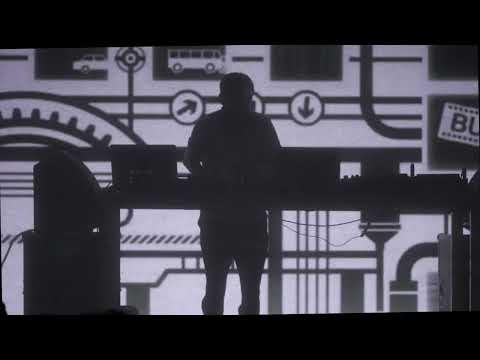
Max Cooper with live visuals at Sonar 2023
Do you use Live to control visuals during your live shows, or is that a separate process and system?
All of my visual controls are set up inside Ableton [Live]. I use Resolume for my live shows and my visuals, and I have macros in Ableton which are set up to control visual parameters. Switching on and off visuals, filter cutoffs linked to visual parameters, that kind of thing. Then I can jam with stuff in Ableton, and it controls the visuals automatically. That's my live show, basically.
It's very simple on the Ableton side of things – it’s mainly just triggering scenes along with some live granular synthesis and drum pads triggering visuals. There are lots of triggers that go to lasers, lights, projectors, visual controls, and I can control all of those just by looking at Ableton. I do look at the visual machines as well just to check how things are looking, but it all comes from MIDI going into Ableton and OSC coming out and into the other systems, and some MIDI triggers for the lasers as well.

Max Cooper’s live visuals
Apart from your live visuals, you’ve often extended your work into exhibitions and installations. Could you talk about the one at the Barbican, “Reflections of Being”, and this idea of people having a physical sensation of the album when they sit down and look at the display?
I was interested in continuing the conversation from On Being, where I started from a collection of publicly submitted quotes which were the basis of the feelings and ideas. Usually when I write music, I have some internal state, an idea and feeling that I want to communicate with people. I put it out into the world and hope that other people can empathize with it and feel some of the same things, so there’s this sharing of human ideas.
It was quite interesting, and really powerful for me, to find that all of those ideas they were feeding me were the same sorts of things that I'd been putting into the music previously. So that was a really nice connection to make with people, even though I didn't know who they were – though I've met some of them since.
The “Reflections of Being” installation idea was to put the audience inside the music and the visual systems, where their shadows would cut a hole in these semi-transparent screens. I set it up in a playful way so they'd be encouraged to walk around on both sides of the installation. When they cut their shadows into the imagery, they'd see through the visual conversations and find other audience members on the other side. I tried to play on the concept of the album in terms of how the installation was structured.
“I've been aiming for something – I don't know if I'll ever manage it – but to make a whole album where there's no sound that happens twice.”
There are benches there with tactile drivers that feed the low frequencies physically into the bench, so you don't hear them, but you feel them. You can actually feel the tones. I love playing with that low frequency bass massage effect. You can get that in a big venue with a really large sound system, but in an installation project where you're not allowed high decibel levels you can still provide that immersive bass communication.
You can get more feelings through, deliver more emotion, whenever you have that extra layer bringing in those extra senses. It makes it a more powerful human experience, which is really what this is all about.
It's reinforcing this idea of connection as opposed to isolation that runs through the album. You're turning audio into vibrations that physically move you, and creating a space where people observe one another experiencing the same work of art.
The interesting thing was, across all of these different people from different parts of the world and all of these different states of mind, there's a real sense that I could empathize with every quote. They're all things where you think, “Oh yeah, I've been in that state of mind. I can relate to something like that.” It shows how similar we all are in the ways that are important.
I wanted the On Being album to be useful, even though it's tackling uncomfortable subjects and encouraging people to think about difficult topics. Some of the submissions were troubled, and sometimes I wrote music as a therapeutic response to those quotes as opposed to trying to represent their darkness. Overall, it just became clear how much more that we share than we differ, despite all of our disagreements and algorithmically fuelled silos. You can explore the quotes yourself directly, and add your own thoughts as the project continues at https://onbeing.maxcooper.net/
Keep up with Max Cooper on Facebook, Soundcloud and Instagram and his website.
Text and Interview: Hal Churchman