Artists
Feb 03, 2026
o[rlawren]: When The Landscape Becomes Sound

Over the past decade, sound artist Tui (aka o[rlawren]) has been quietly shaping an expansive body of electroacoustic work from a remote cottage in the hills of Dumfries & Galloway, Scotland. Living three miles outside the nearest village, with no neighbours and only the shifting Scottish cloud, rain and wildlife for company, this self-imposed isolation has become both his studio and his collaborator. Working primarily with a Eurorack modular system and Ableton Live, Tui’s music inhabits the emotional space between organic sound, field recording and digital processing, rendering the minutiae of nature into fragile, intimate sonic forms.
In September, he released two albums simultaneously on the Dronarivm/Fonodroom label: The Intimate Overlap and Poiesis. Though different in temperament, both are interconnected by long-distance collaborations, long-form modular improvisations, meticulous editing and the renewed perspective of revisiting material that had been years in the making. Under the o[rlawren] guise, Tui’s work continues to reflect an ongoing exploration of ecology, perception and sensory immersion, shaped as much by place as by process.

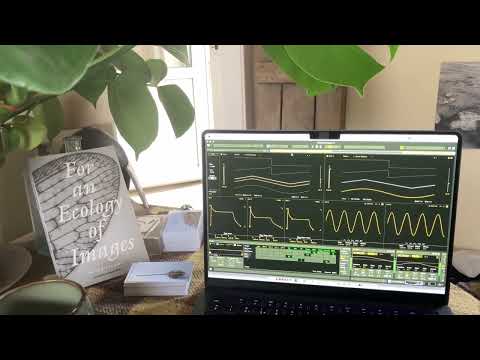
Promo video for o[rlawren]’s Poiesis album
For almost a decade, you’ve been producing from the hills of Dumfries & Galloway. What lay behind your decision to work in such isolation?
I’ve always gravitated towards and spent a lot of time in remote places, and although I’ve travelled a lot, I held a dream to live quietly and situate my studio in a landscape that I love. These kinds of places tend to be found through word of mouth, so I do feel very fortunate to have landed here. High Todholes is a very small cottage high up above a working sheep farm, three miles uphill from the nearest village. Over the centuries, the original house, which is now my barn and wood store, was used to house the farmhands and their families, but according to local folklore it was quite often struck by lightning so my cottage was built nearby in the 1950s. I work on music most days at various times, but tend to achieve a lot in the morning after a green tea.

The barn next to o[rlawren]’s cottage in Scotland
How does solitude shape your approach to sound and emotion in your music, and how does your interest in ecology inform your art?
To really listen is such a personal experience and in doing so I find myself becoming entirely immersed. I’ve been told that my music has a strange intimacy and I think there’s a vulnerability to that based on having an ecological relationship to sound, or a way of listening to the world in relation to a re-wilding of systems as a step towards caring about all living things. To me, success lies in the realisation of an idea and having it named and turned into a body of work that’s experienced, shared and left for others to find. It’s often quite a struggle to articulate what I intend, so it’s all the more rewarding when I can consider a project complete.
“I’m looking for a different perspective – a tension in the opposites or a different way to listen.”
Does your neurodivergence also influence your perception of sound as some sort of communication system for emotion?
I really do consider sound to be a living ecosystem – a conversation between matter and perception that holds a very special place and allows me to connect and articulate my presence in the world – especially as those neurological functions are something that I ordinarily have some difficulty with. Balance is important though. Although I live in quite a remote place, you’ll often find me out and about on my bike or walking the hills. It’s actually only a 50-minute walk down to the village and train station – and from there it takes just over an hour to get into the centre of Glasgow. After returning from the city, I nearly always have a good musical session. Perhaps that’s relief, but I also enjoy the buzz of watching and being amongst people for a while. I’m very friendly, but not too sociable, so it’s always great to walk up the hill again and get back to peace and quiet.

Promo video for o[rlawren]’s The Intimate Overlap album
You’ve released two LPs recently that were created across very different timespans. How would you differentiate the two albums in terms of their sound, atmosphere or reason for existing?
There’s a commonality in the equipment and techniques used, but Poiesis was informed directly by being absorbed in other people’s work. It was the first time I’d made an album that way and I really enjoyed the process, so I’m actually continuing this method into 2026 with a new work Epidermis - w/ Lourdes González Osnaya. The Intimate Overlap is a much more personal album made shortly after my mother died in July 2015 and after I’d relocated to Scotland. In a lot of ways, the album was a way for me to begin processing what happened, which perhaps reveals why it took such a long time.

o[rlawren]'s field recording kit
Tell us about the sonic landscape around your cottage. Do you often record there or prefer to go further afield?
It’s beautiful and very quiet with no traffic noise at all, so I make a lot of recordings here when I’m out and about - especially in the barn. It has wooden floors that creak and the wind makes the doors rattle, so I’ll often go in there to make field recordings and record acoustic instruments. A few years ago, I bought some Primo ECM172 omni capsules for field recordings, made by Spanish field recordist Edu Comelles. They’re really small stereo binaural mics with a very low self-noise of 14 dBA and flexible casing that can be discretely bent over your ears. I record everything on them, including acoustic instruments, because they’re very detailed, quiet and can be placed apart from each other behind things. They fit in places that normal mics can’t, which is a crucial aspect of my recording process.
Are you looking to record specific sounds or is your search for field recordings a more intuitive process?
I’m always recording and trying to capture something unexpected that I can edit later, but even if I’m recording something specific, I’m looking for a different perspective – a tension in the opposites or a different way to listen, so it’s definitely an intuitive process. When possible, I like to place microphones in situations overnight. For example, on my 2021 album The Blind Deaf Stone I was able to place them in my neighbour’s chicken house and record some very close miked noises, including the sound of them snoring, which isn’t something you readily hear from a chicken. That recording made it onto the track Sleeping Birds.
Your main instrument is the Eurorack modular system. What drew you to modular synthesis initially?
I grew up at a time when modular synths were huge and very expensive mythical objects that were financially out of reach for most people - it was very unlikely you’d ever see one in a synth shop! As a pre-teen, I used to go to Sound Control in Newcastle every Saturday and play around on their Prophet-5 or Juno-60. I couldn’t afford them of course, but my dad did buy me a mono synth when I was twelve – a grey Roland SH-101. I later got a Casiotone VL1 and a KAY DRM-1 drum machine from KAY’S catalogue. I’ve used a lot of different synths since then – mostly monophonic as a preference, so when the Eurorack format arrived I found it very compelling that you could build up a very small but capable and personalised system for relatively little money. But it’s very rare that I‘ll work on something directly from an improvised modular session. I might place a small note if I think it’s particularly promising, but at that point I’ll often do further editing in Ableton Live. I’m always looking for sounds that surprise, excite or make me feel something particular.

o[rlawren]’s collection of acoustic and electronic instruments
You also used acoustic instruments across both albums. At what point are they recorded and embedded into a track?
I’ve travelled to a lot of countries throughout my life and often picked up instruments from people who made and sold them directly. They’re mostly ornaments of inspiration, but they do occasionally make their way into a piece of music, so there’s a few acoustic instruments littered around the studio such as a clarinet, dulcimer, zither, duduk, dilruba, and various whistles. I record them using the Primo mics I mentioned, but it’s rare that I’ll play anything directly on a track because that’s not how I tend to compose. My process is to drag things in from previously improvised sessions until the pieces fit together and I like the naivety of recording instruments that I can’t play very well.
Is it tricky to balance acoustic instruments with digital manipulation, or weave environmental sounds into modular textures without them losing their identity?
I think it’s mostly down to a process of light editing and taking extra care when it comes to manipulating source material. These days, you can chain together endless modulation and effects possibilities in Ableton itself and that can quickly get overwhelming, especially when using a modular system alongside it. For me, it’s always been a process of folding things in and out of each other to retain some sort of integrity or sonic identity that’s related to the original sound source. At that point, I’m listening to things as a whole with an ear to what needs to be taken away or added. When I can’t do that process anymore, I consider a piece complete.
How has the shift from using synth hardware to a more hybrid modular/Ableton approach changed things for you?
It was a huge change going from having 2MB of memory in my Emu sampler to being able to record extended improvisations without limit directly into Ableton. In 2004, I went from using a copy of Cubase on an Atari STE to employing Live on a laptop for the first time and that really changed my music and working methods. Looking back, my debut album Butterfly Wings Make has a naïve charm that came from not being sure what I was doing. I’ve obviously learnt various techniques over the years, but I think there’s value in not getting too stuck on a particular way of working. Discovering something new is really exciting and modular fits so well into that way of thinking because there are no presets and even if you patch sounds in a similar way you can be sure that you won’t get the same results twice.
You’ve mentioned that everything passes “through or from” the modular before entering Ableton?
Both The Intimate Overlap and Poiesis were made using different Eurorack modules as sound sources, and the Eurorack system is amazing for creating really unexpected sounds or just subtle enhancements, which I find really inspiring. I’m not any kind of modular expert, so I never start off with any kind of idea of what I want – I’ll just improvise, record everything, edit it in Live at a later stage and often re-process through the Live plugins. For me, both methods achieve different results, but Live really comes into its own when I’m in the arrangement and compositional mode.
Tell us more about that process?
When arranging a track, it’s always done in Ableton’s Arrangement View, layering things together and listening to see what reveals itself. I don’t work to a BPM as my music’s rarely percussive, but I like to be free from a grid and allow things to find their place. One of my favourite aspects of the compositional process is having no idea what files are going to be brought together and when or how they were initially recorded. During my initial sound design sessions, I’ll use a lot of LFOs to create changing modulations between sounds, but during the compositional and arrangement process I’m much more detailed and precise in my editing. That’s where the automation of parameters in Live is key.
A snippet of one of the pieces included in o[rlawren]’s sample pack
You’ve used Ableton Live since version 4. How has your relationship with the software evolved since then?
In a sense, I’m still using Live in exactly the same way by editing audio in the arrangement window, but the newest iterations of Live have some great plug-ins to explore. The changes and upgrades within 12.3.2’s Auto Filter and Limiter are excellent and I find Wavetable and Meld to be very powerful synths. I’ve also recently enjoyed using the new Roar plugin during the sound design stage in my compositional process. The modulation possibilities seem endless and manipulating the feedback offers unexpected and dynamic results that give a lot of presence and movement to any sound that you might feed through it. An example of Wavetable and of Roar would be in the sounds 9.Wavetable and 3.Sine Melodies included in the treated sample pack.
Download o[rlawren]’s free sample pack
“A few sounds of mine that show how I use Ableton to shape those same sounds into something different/musical/abstract or just with some subtle movement.”
Can you talk about how you integrate Max for Live into your process?
I mostly use the Max for Live plugins when I’m having sound design sessions and use other Live plugins like EQs and compressors when creating the final arrangements of a track. A much used plug-in for me is Looper, which I always use to create overlapping melodies. Sometimes, I’ll have my mono synth plugged in with an effects chain automated by LFOs placed just before Looper so I can improvise layers and render out anything that feels good. As I mentioned previously, I use a lot of LFOs to create movement within various parameters of plugins like Delay, Echo or Roar. For subtle textural work, I’ll use the Granulator III sampler to create further unexpected manipulations.

o[rlawren]’s studio space
You mentioned a new project this year, Epidermis, with Lourdes González Osnaya. What can we expect?
I’m very excited about this project - Lourdes (Lulu) is an amazing textile artist from Mexico and I was immediately drawn to her project employing the innate poetic language found in materials associated with funeral rites in Mexico and their transformation over time. In particular, the epidermis is skin from onions, which is traditionally used at wakes for protection and a shroud, which can take up to three years to complete. Lulu uses these traditional techniques in her beautiful sculptures and will be using my sound work for future installations and exhibitions. Sonically, it will be very minimal, experimental and meditative, using close miked recordings of the onion epidermis as a starting point. That will then be sent through the modular and the results of this experimentation will be offered for improvised contributions from students on the Performance in Woodwind degree course at the Royal Conservatoire of Scotland in Glasgow.
Follow o[rlawren] at orlawren.co.uk
Text and interview: Danny Turner
Photos courtesy of the artist