Artists
Downloads
Nov 05, 2026
Download the Live Set of Hiroko Yamamura’s New Track “Weight of It”

Is it possible to love dance music without ever feeling entirely at home on the dance floor? Hiroko Yamamura thinks so. As a young raver growing up in the Chicago suburbs, she paid closer attention to the DJs and the sound equipment than to the revelry around her. “I’m not much of a dancer or conversationalist,” she explains. “But I was fascinated by how all the gear worked.”
That curiosity proved lasting. Yamamura has gone on to build an international career spanning clubs and festivals across North America, Europe and Asia, with appearances at Movement Detroit, Panorama Bar and Fuji Rock among many others. Her discography includes solo releases, remixes and collaborations on labels ranging from Trax Records and Planet E to !K7.
Having watched scenes, technologies and industry fashions come and go, Yamamura has a particularly clear view of where club culture finds itself today. She speaks candidly about the financial pressures facing artists and venues, changing audience habits and where those shifts might lead next, without pretending to have easy answers.
In our conversation, presented in association with Crack Magazine, she discusses listening as an education, the economics of nightlife and the role of chance and randomization in making music. She also takes us inside her new track “Weight of It”, exploring what happens when a hardware-led producer brings their instincts into a software environment. Readers can download the Live Set to explore the project for themselves.
Download the Live Set to Hiroko Yamamura’s track “Weight of It” here*
*Requires a Live 12 Suite license or the free trial
You came up around Chicago but not necessarily as someone who set out to become an artist. How did you find your way into electronic music?
Initially I was more involved in indie rock and industrial music. I ended up at rave parties almost randomly, as something to do.
I had been in bands in high school, but the idea of doing things on my own was very appealing. I didn’t have to organise people or find time to practise together. Learning the technology got me into studios quickly. I would not say I was especially creative at that point; I just knew the tech. I knew drum machines, MIDI and software. This naturally led toward making music, even if that initially meant editing Radio 1 rips or putting a beat under a Mega Man song. The tinkering and discovery came first.
You draw a clear distinction between being referred to as a participant in the Chicago music scene rather than a pioneer. Why is that important to you?
Those accolades are used too freely now. It takes something away from the people who were doing the work when it mattered, especially if they never cashed in on it.
During 1990s I really started paying attention. Listening to early-1990s tracks created without any blueprint or reference to build from meant innovation was inevitable. When I heard songs by Juan Atkins and Kevin Saunderson, I could really feel this idea of electronics being harnessed to elicit emotion without adhering to what I understood as traditional song structures.
In Chicago, we all came up on DJ Hyperactive, who was largely formative in creating the template for the American techno sound. His early tracks were wild session recordings of traditional Roland gear slammed through various effects and a Mackie mixer.
I witnessed the gravity Richie Hawtin and John Acquaviva had in the Midwest, and how drastically the sound changed alongside the scene.
It’s important to recognise the people who were at the forefront of developing something when there wasn’t much monetary gain. The few avenues that existed for making a living in the industry were quickly funnelled towards those with the connections or outreach, and often did not result in situations with which all parties were satisfied.
I am just a fan and a consumer who has had the chance to go along for an amazing ride. While I hope to contribute music and DJ in my own way, there is no doing any of this without the guidelines and structures put in place by the people before me. Of course, any of us would hope to innovate at that level, but I guess I have not got there yet. Who knows, maybe I can.

How did your early involvement in the scene evolve into working in music professionally?
It is often just how I enjoy things. I want to be involved rather than simply show up. Some of it is about social comfort. If you don’t feel comfortable on the dance floor and you don’t know anybody, working at a show gives you a place in it and something to focus on.
I also worked in music journalism. I got free music, I got backstage at shows, and it was exciting to see my work published. It was a way to participate and give something back. You find your own way to be part of the thing.
“Art is not fair and the world is not fair. You can check every box and still not get an equivalent return.”
Music production is far more accessible now than when you started. Do you think that democratisation has improved things or created new problems?
It is a sliding scale. There were as many bad records as amazing ones in the early days. The technology was unfamiliar and experimental, and there was scarcity in the market. If you had access to the machines, knew somebody and made acid house at the right moment, you probably had something going on. There were relatively few people making records, which is why one person might have worked on songs for many different artists.
The limitations set the standard. Rudimentary samplers had a sound; you could hear the time stretching and often identify the instrument. When I started, I used Impulse Tracker. You could pitch notes, but adding something like a decay meant entering numerical values. After the fiftieth event, you might not bother.
Now you can do almost anything. That makes it harder to distinguish the person who has spent years learning a craft from a beginner purely by the surface of the finished product. At the same time, the happy accidents produced by new tools are still what interest me.
Some mystery has gone though. People know which kick and sub frequencies will move air on a festival system and exactly what to notch out. Before, you found a kick that worked, put it through a compressor and crossed your fingers.
But I do not romanticise the past too much. All this technology is built on discoveries that worked. We had to get here, but we are not going to stay here.
As technology makes it harder to distinguish between years of craft and something produced almost instantly, where do you think that leaves younger artists entering music today?
Not being tied to that history can be freeing. My generation inherited rules about what this music should be and what deserves reverence, and those rules can hold us back. Younger artists do not owe the past the same allegiance. Older generations not fully understanding what young people are making is part of the music’s ethos: it connects us, but it also has to move forward.
A lot of younger producers I meet are better educated about the tools than older people because they sit down and make things. But, they also have less to look forward to financially. Ten or fifteen years ago, a label might invest in an artist with production money and studio time, and a ghost producer in the right circle could make a living. That baseline is not there now. If people still learn the tools and sit with the craft when the odds of financial success are one in a million rather than one in a hundred, I give them a lot of credit.
“Often the tracks you worked hardest on are not the ones that perform.”
What do you think keeps artists in the game when the financial returns keep shrinking?
You have to get something from the work itself. Art is not fair and the world is not fair. Some of the best bands I have seen were playing to five people in a bar. You can check every box and still not get an equivalent return.
While you know what you put into the song, you cannot expect the audience to know that. Months of work do not automatically change your streaming numbers. Often the tracks you worked hardest on are not the ones that perform.
After that heartbreak happens enough times, you stop expecting every promise to be fulfilled. The label did no promotion; the person who signed the track did not play it; the push you discussed never happened.
At some point you are committed though. Like in a poker game. You think, what else am I going to do? You may go down with the ship and decide at the end that it was a mistake.
It is unrealistic to pretend that nobody in music wants success. Of course I would love to buy my mom a car with a record. You need some version of that dream to keep moving. The worst thing can happen, you can feel completely done, and the next morning you are back chasing the same ridiculous one in a million chance. You have to respect the people with that amount of delusion. We are in it, so we might as well put our best foot forward.

It’s been well documented that audience habits are shifting. Young people appear to be consuming less alcohol and going out less. How is that affecting the economics of club culture? Is that model breaking down?
In my own circle, many people have lost work or experienced an economic change. They have less spending money than they did a year or two ago, or they are budgeting differently. I am budgeting differently. The cost of going out is something I think about now.
I have seen a lot of tours and events cancelled, as well as festivals hit by extreme weather. Those losses affect the next operating budget. I do not know whether drinking is going to come back, and I am not an expert, but many people simply do not want to go out, get crazy and pay for it for two weeks. Younger people may also have watched their parents do that and decided it is not for them.
The question is how clubs fund themselves when bar sales are their main resource. Stereo in Montreal is an interesting model because it does not serve alcohol and relies on ticket sales. That creates a clear understanding that operating the room costs money.
What happens to artist fees and programming if venues cannot keep absorbing those losses?
Mid-sized clubs have sometimes treated a superstar booking as a loss leader, assuming the prestige will bring people back later. Too many have taken that loss repeatedly. At the same time, audiences have come to expect a top ten DJ at their local techno club, even when that venue is bidding against festivals.
I think that will fizzle out and produce a reset. Venues may stop competing for the highest fee, which could create opportunities for artists in the middle. Management companies may also become less willing to front money to develop a future star because it is now such a risky investment.
The clubs will still be there because the people who want to do this are committed. But I expect less money across the industry, which means less investment as well as real consequences for people in the industry. Whether the correction helps or hurts depends on where you are standing.

Let’s turn to the Ableton Live project that you’ve shared. What was the premise of the track?
“Weight of It” is a studio jam built from a single bar loop. I had got my hands on an Ableton Move and I treated Live like a multitrack recorder.
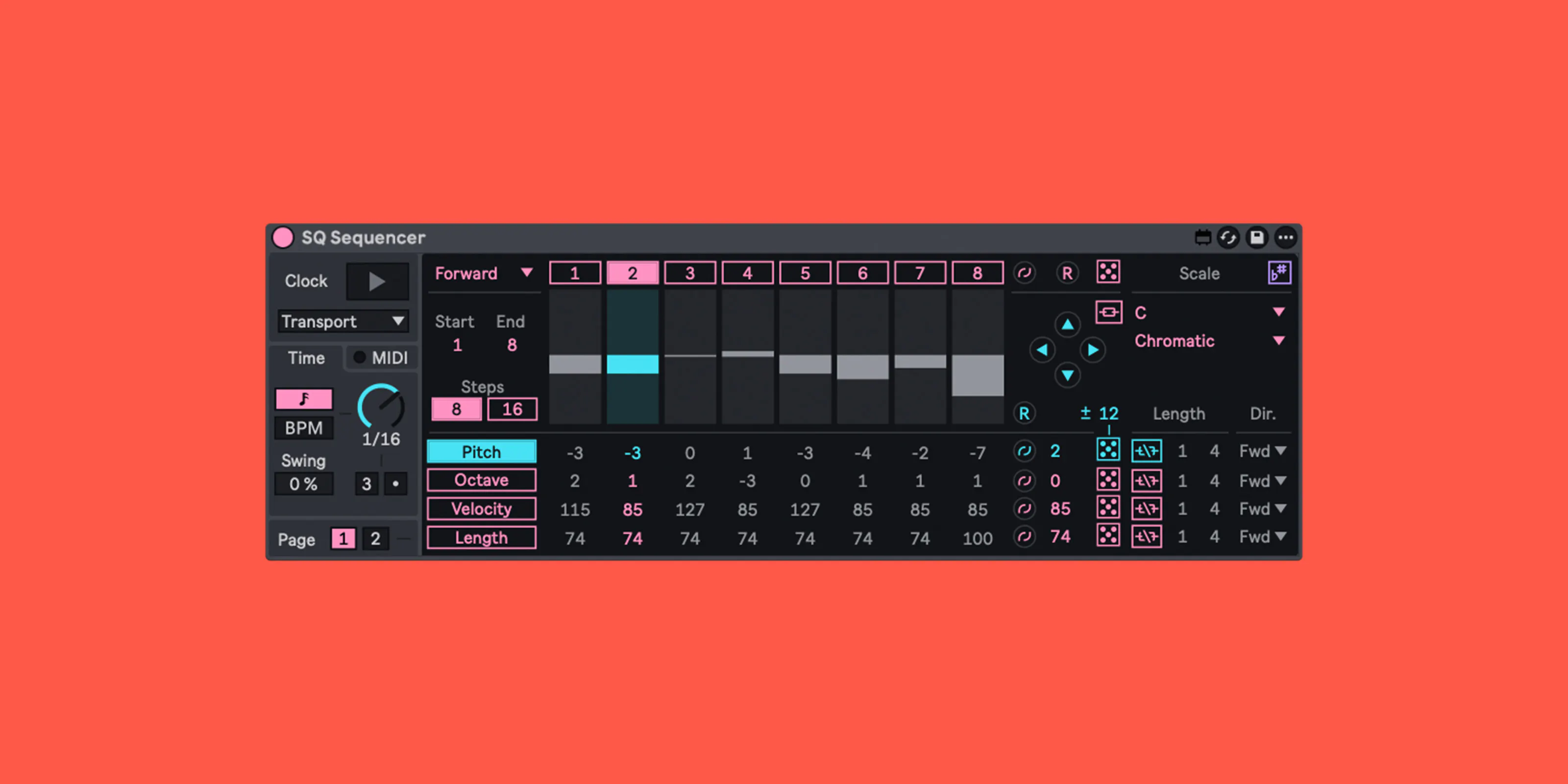
I anchored a lot of the work around the newer Max for Live Sequencers. I used some generative elements, randomized the parameters, and recorded the results. The SQ Sequencer might run while I armed and disarmed steps or moved filters. The point was to find an interesting groove across eight steps and record the changes in real-time.
The SQ Sequencer shows up a few times across your Live Set. What drew you to it so much?
You can set up pitch, octave, and velocity, then introduce randomness with the dice controls. The device triggers the notes while the dice controls generate variations in those parameters. That combination was the appeal. I played with other parameters like filter cutoff while the sequencer ran. The most simple sequences can be made exciting and fun with just a little filter and decay at the right time.
How did the Rhythmic Steps device influence your drum programming?
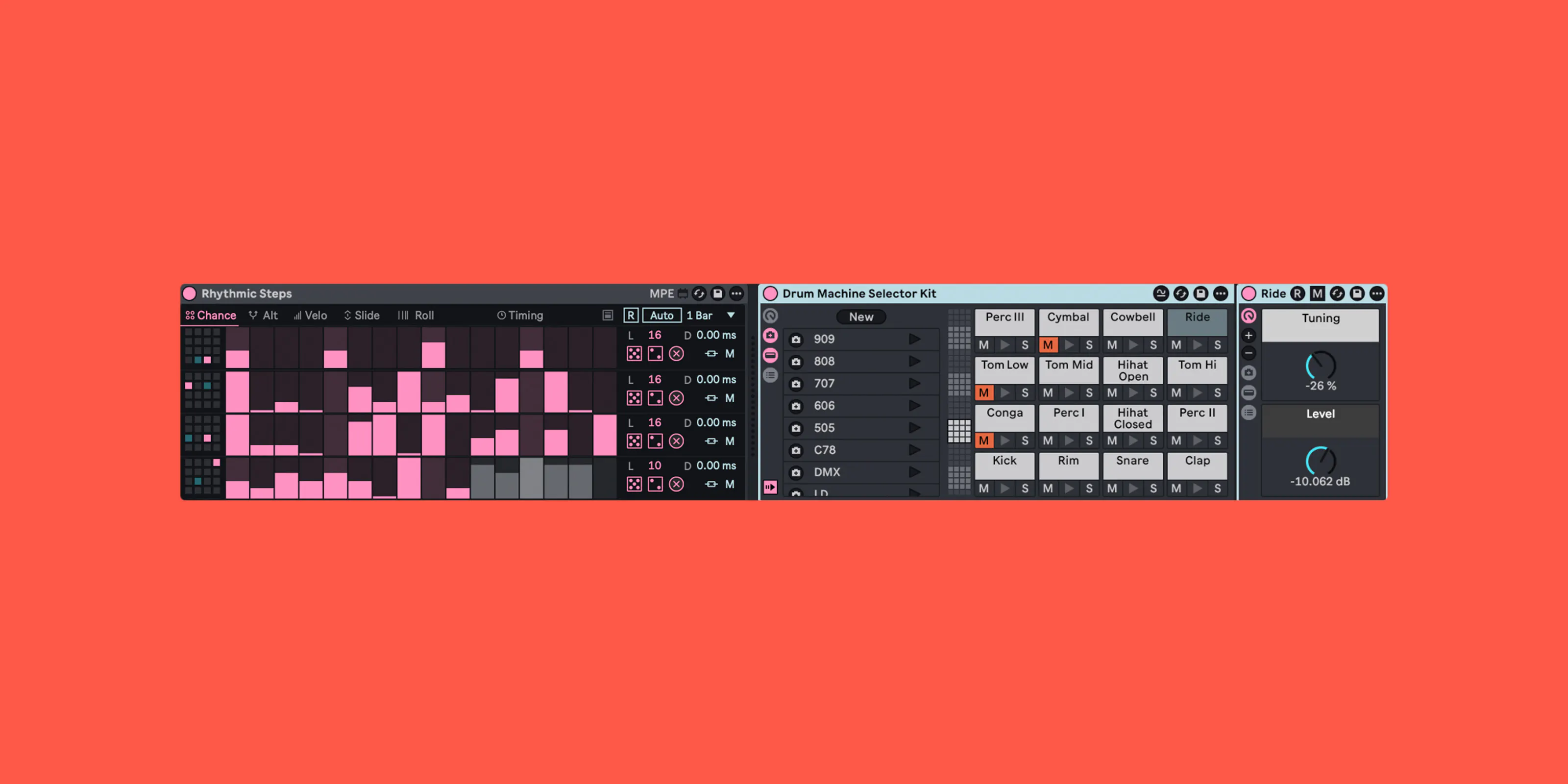
The chance control is the useful part there too. You map the device to a Drum Rack, choose a drum sound, put in a basic pattern and assign probabilities to individual hits. If you let it run, you get variation. I can record several bars without hearing the exact same hat pattern repeat.
You could call it a lazy way to create shuffle and variation, but it is effective. If you are stuck with a rigid sixteen step pattern, a little chance can add interest. Ableton bringing this kind of device into its own ecosystem is especially useful for somebody like me who is used to hardware jams.
What do you gain and lose by recording the sequencers in real time?
A running sequencer gives the part a little mind of its own. With a hat, I might move the decay or tuning very slightly and capture that in one take. That is more interesting to me than drawing a bar, copying it and planning every change. If I work that way, the track often becomes static.
The disadvantage is that I initially recorded everything as MIDI, including volume changes. When it came time to mix and something was obviously too loud, those automations came back to bite me. I should have printed audio sooner. I had to work out how to reduce the gain without destroying the performance.
The same thing happens when you record mutes. In the arrangement, all those decisions remain as automation. If the Live Set is already messy, you see controls blinking on and off and have to find the correct lane to clean them up. My mixing process begins with gain staging, and after you undo all that automation you do not always get back to the level that originally felt right.
When several generative sequencers are running, how do you keep the patterns from fighting each other?
For me it is a matter of stacking. I do not arrive at the sound until the basis is there, and a lot of the material in the project simply did not sound right. It was not always a note or spatial problem. It just didn’t work.
With several sequencers you want some intentional clashes, especially in techno. Tension and dissonance is useful, but that is not the same as making something bad. If you arm every step while a long FM tone is moving underneath, there is too much going on. You have to leave room.
I usually start with too much and reduce it. A single bar can be dragged out, changed, recorded and committed as you go. That works for a percussive DJ tool; it is not necessarily the best method for a song built around verses, choruses and a breakdown.
The focus can also shift. A rhythm or a tone becomes the star of a phrase, then hands that role to something else.
Several sounds go through long chains of effects. How intentional was that process?
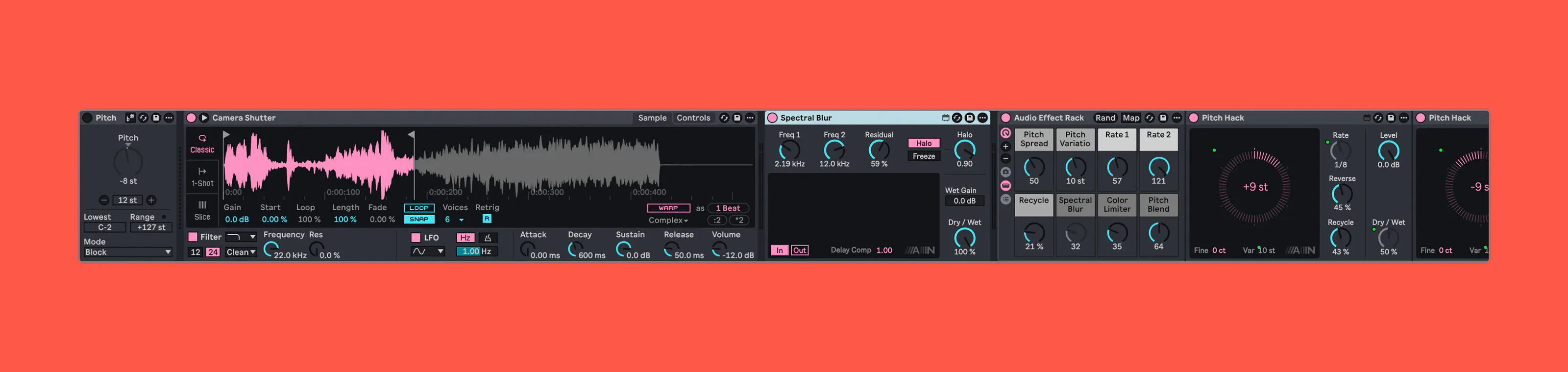
Some of it was simply piling on things that sounded cool. One vocal-like sound started as an asset from a video game pack. I wanted a long tail and a slight stutter, so I tried Dynamic Tube, Echo, plus Pitch Hack and Gated Delay from the Creative Extensions pack. There wasn’t a scientific explanation for every device.
Ableton's presets are powerful, and I like working backwards from them. Some people prefer the initial state and build everything themselves. I can find inspiration in the examples, especially because many are already synced to the project clock. Even changing Dry Wet can turn a preset into a different effect.
With a modern computer you can stack a ridiculous number of effects, listen, and turn off the ones that make no difference. There is freedom in that.
You also used Erosion and EQ Eight on a vocal. What were you listening for?
Erosion takes information out and leaves gaps in the sound. Then EQ Eight helped move the vocal out of the way of other elements.
I used the instrument specific presets on EQ Eight as starting points: hats, kick, vocal and so on. In this case I think I started with a vocal preset and shifted it slightly.
An EQ preset cannot know the source, so it is not a final answer. But if you do not know the tool well, it makes an initial decision about the lane that sound might occupy. I am bad at reduction because the most recent thing I add always feels as if it should be louder and more important. A broad preset gives me some space to begin taking frequencies away.
There is a camera shutter sound processed with the Spectral Blur device. What did that experiment add?
The camera shutter is a stock Ableton sound. I first put it in Simpler, chopped it and triggered it with SQ Sequencer, but that felt as if I was doing it only for the sake of doing it. I went back to the sound, shortened the tail and moved the filter and added a Beat Repeat. The track is minimal and percussive, so it works almost like foley and adds texture.
With Spectral Blur, I started clicking. The whole track was partly about familiarising myself with the tools. You do not always need a scientific explanation. You can maul a sound, then remove the processing that does not help. The goal is to move the sample away from its original state and make it respond to the rest of the track. It should be in key, or out of key intentionally, and rhythmically connected to what is already there.
You tried various basslines and kept only one of them. What made you decide not to use the others?
There are bassy sounds in the track, but not a conventional bassline. I thought there should be a dotted eighth note runner underneath, even if only to demonstrate the idea, but it did not fit. The kick is boomy and its tail occupies a lot of space. Every bassline made the arrangement too busy.
There is a quiet acid line near the end to keep the energy moving and avoid repetition. Otherwise I had to accept that the track did not need a bassline. Reaching that conclusion is difficult. There are many times when I force the relationship and end up with what sounds like a circus song. That is when I close the session.

Did you control the session with Move or work mainly with the mouse and keyboard?
It was a combination of Move in Control Mode and the mouse. Move brings forward six or eight common controls for the device in focus. They are not always the parameters I want, but it is useful when they are.
Something deeper may still require the mouse. Live makes it quick to enable automation and move a control, though.
My goal was to use a single piece of equipment. Other controllers in the room would have made the process easier, but I decided not to use them.
What did staying inside Live change for you?
Until now, I had not really treated Live as a complete instrument, but this reminded me how powerful and self-contained it can be. Leaving the hardware alone was a genuine challenge, but a productive one.
Like any instrument, its tools inevitably shape the sound. The focused possibilities of the sequencers and stock Drum Racks give useful constraints while making it easy to get an idea moving quickly.
If somebody wanted to adopt my approach to starting a track in Live, I would point them towards those sequencers, chance controls and preset Racks. They can take you somewhere fun and inspiring before you have time to overthink it.
Keep up with Hiroko Yamamura on Instagram and SoundCloud
Text and interview by Joseph Joyce
Photography by Georgia Modi
A version of this article appears on crackmagazine.net