News
May 26, 2026
From Lego Prototype to Standalone Instrument: The Evolution of Push

The original Push prototype was recently included in the culturally significant instrument collection of Australia's Powerhouse museum. Check out the video they made for the occasion with Jesse Terry, Ableton’s head of hardware and the mind behind Push.

We also asked Jesse to look back on the instrument’s origins and reflect on some of the thinking that went into its evolution and purpose. Here’s what he had to say.

A neolithic bone flute.
Let's rewind to the beginning. The first musical instruments we know about were things like this flute. Even in this simple flute, we see something of the identity of the player, and presume a measure of possible expressivity that equals (or even surpasses) what is heard in a lot of instruments today.
On a modern keyboard, you press a note and you might hear its velocity, but it is on pitch and has a static tone or timbre. That kind of instrument misses the expression that was available even in our earliest instruments.

Schematic of one of Edison’s recording devices which inscribed sound onto wax cylinders.
Another major historic moment for music was the wax cylinder recorder. For the first time, we could record what we hear, and play it back somewhat like what it sounds like. Of course yesterdays ‘bad sounds’ be it wax cylinder, vinyl, tape, cassette, CDs become this generation's sounds to aspire to, and you’ll find a lot of those sound shaping plugins in Live and on Push.

Les Paul in his studio, 1950s.
Les Paul is one of my personal favorites, as he invented both the electric guitar and the multitrack recorder. With the multitrack recorder, music as we know it changed forever and allowed all the experimentation and multitrack recording techniques that have come since. He was also a great guitarist, and he and his partner Mary Ford did incredible things to overdub precise layers of her voice and his guitar. This was groundbreaking at the time.

King Tubby in his studio, 1970s.
In the late 60s and early 70s we start to see producers become integral to the song. Whether it was George Martin with the Beatles, or Lee Perry or King Tubby as we see above. King Tubby was an engineer as well as a producer, and he wired things differently. He also used the mixing board, and faders on the mixer as an instrument, where we would bring instruments in and out and use effects to shape the sound of his songs.

Robert Moog with an array of his company’s electronic instruments, 1970s.
In the 1970s synthesizers such as Moog, and APR along with sequencers and drum machines started to come into play. This led to some incredible music that is still relevant for electronic music, whether with Kraftwerk or Georgio Moroder, disco, hip-hop, R&B and pop music that would come next.

Korg advertisement featuring the then new MIDI feature, early 1980s.
In the 80s we got the first MIDI synthesizers, and studios began to come under the control of MIDI. With MIDI, everything could be synced together, and computers could control the notes, sequencing and automation of a studio.

Beat machines of the 1980s: E-MU SP1200, Akai MPC, Roland TR-808.
The 80s also brought us sampling and drum machines like the MPC held by Roger Linn here, that you could play with your fingers, or the 808, which you would program sequences on. The SP1200 and MPC ushered in a new era of music in hip-hop and pop by the way producers would chop up and manipulate samples, and by the swing functions and particular sonic character they introduced.

Gerhard Behles and Robert Henke performing as Monolake, late 1990s.
Musicians needed a way to take this electronic music onstage. In the 1990s many artists took mountains of rack mount gear, synthesizers and mixers onstage to do a lot of complicated stuff onstage. The photo above is Ableton’s CEO and founder Gerhard and Robert Henke, playing in their techno group Monolake in the 90s.

Session View of Ableton Live 1, 2001.
In the 2000s we got to the place where everything I’ve shown you previously could now be done on a laptop. Ableton Live also brought some innovations like Session View, where you can perform and launch ideas and mix and match different song parts together. But for me it was the warping. The ability to stretch time, so that samples of any BPM can be played back together is what grabbed me.

Monodeck, Robert Henke’s original controller for Ableton Live, early 2000s.
But now that everything was inside a laptop, musicians missed the hands on dedicated control of different aspects of their music. Using a mouse and looking at a laptop didn’t cut it - it is not a dynamic or interactive way to perform. Even artists and Ableton founders Robert and Gerhard missed turning knobs and pressing buttons, and controlling multiple aspects of their sound at once. Above we see Robert Henke’s first homemade controller, the Monodeck, made for controlling Ableton Live.

MIDI controllers, ca. 2003-2007.
In 2005, when I joined Ableton, MIDI controllers were exploding. They covered lots of use cases, but they were quite generic, and often required complicated setups.

Monome, a highly customizable, open-source controller, ca. 2007.
The Monome came out and represented an extreme: it could do almost anything but required people to code their own idea of how it worked. These were flexible and powerful ways to control a computer, but they weren’t easy to set up and were a bit generic for certain use cases.
In 2007 we started to see other controllers customized for Ableton by artists like DJ Sasha and Richie Hawtin, and Robert Henke’s second Monodeck. These were built specifically for Live, but were expensive custom solutions that still needed a lot of programming work to control Live.

Akai APC 40, one of the first devices made to control Ableton Live.
That’s when we made the APC40 and Launchpad, which worked as soon as you plugged into Live, without a lot of custom setup. Those products were and are great for performance, but I wanted something for creation, coming up with ideas, and fast workflows.

A rough idea of Jesse Terry’s original vision for Push.
I wanted to make something that married the flexibility of Live’s drum programming, sampling and time stretching with the feel of classic drum machines like the Akai MPC 2000 XL that I started on. And I wanted to add the quick joy of step sequencing from classic products like the 808. The first sketches I did for Push were drum based products. And from the beginning, I wanted Push to be standalone but that would take some time.
Gerhard came to me one day and said, this also needs to play melody and harmony, and needs to fit into a backpack. I was like: ‘oh great’.
We wanted an instrument that anyone can play, without much training, but that would allow for virtuosity if mastered. We didn't want musicians to have to spend years learning how to navigate white and black keys, only to play the same chord in twelve keys.

Alternative musical interfaces and layouts.
So we looked into a lot of weird stuff. Things like the bandoneon, Isomorphic Janko keyboards, Atari hotzbox and hexagonal button layouts. Ultimately, we ended up with a grid as we also wanted to launch clips. Our innovation was making it isomorphic, where you can play the same shape for a chord, but we also made it diatonic, meaning you can fold the notes to get rid of the ‘out of key’ notes. No one had done this before.

Design inspirations for Push.
We also had a lot of opinions about industrial design, and drew on influences from our industry like AIAIAI, Monome and teenage engineering, as well as classic Braun designs by Dieter Rams.

The original Push prototype. Now in the collection of the Powerhouse museum.
So at this point I did not have a hardware team, but I ended up sawing a bunch of controllers apart, and gluing buttons to Legos to make a proof of concept. Above is my first prototype of Push 1. We tested it with people like Flying Lotus and Jazzy Jeff and thought we had a good idea.
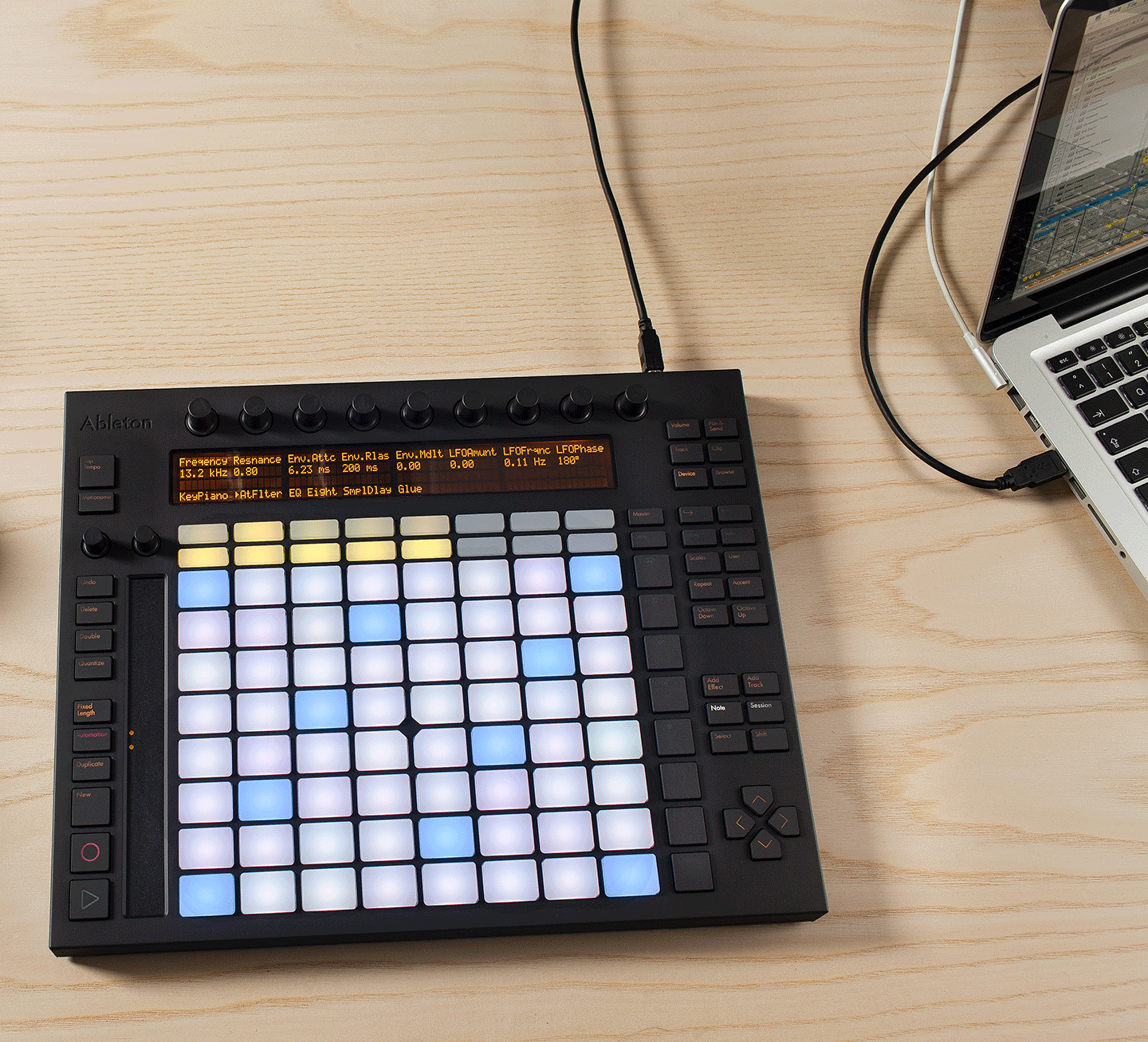
Which brings us to 2012 when the first Push came out. Akai Professional agreed to engineer it, and we did the design and sold it. For me, it was a huge moment for me when my hero Herbie Hancock first tried it, and was able to master it in seconds.

Push 2, 2015.
Push 2 was all about the display, and beginning to make hardware in house. We were now able to spend as much time as we wanted refining it, and able to show samples and other things on the display.

Push 3, 2023.
Push 3 followed almost 8 years. At the time, our CEO said to me, that in the history of humankind, no one has put the kind of effort into making an instrument that we put into Push 3… a terrifying thought for me. In many ways this project was about preferences and setup. The standalone part is really about focus.
The challenges were many: we had to create an operating system, we needed to deal with porting Live to Linux, we needed to deal with all the gory details of WiFi and authorization. But we also made our own expressive pads that are so sensitive they can actually sense your finger before you hit the pad. There are tons of microcomputers inside that handle all this data, and while we have cool stuff in Push now, there is a ton more we can do which is why we’re always adding functionality with new software releases. Over the whole arc of Push’s development, the intention was and remains to allow electronic music makers to get some soul and feel into their playing.
Text: Jesse Terry
Learn more about Push