Artists
Downloads
Apr 09, 2026
The Black Dog: From Rothko to Roland to Ableton

The recent death of Ken Downie marks a quiet but profound rupture in the UK’s electronic underground. As a founding force behind Sheffield techno trio The Black Dog, Downie helped shape the early identity of Warp Records, steering the genre away from pure functionality toward something more conceptual and enduring - redefining how people thought about electronic music.
That legacy casts a poignant shadow over Loud Ambient, the group’s latest LP and one of its most confident statements, as Martin Dust and Richard Dust continue to shape its direction. Originally inspired by the colour-field artistry of American painter Mark Rothko, the project evolved into something more kinetic, interplaying melodic ambient textures and propulsive rhythms that feel surprisingly immediate.
Richard Dust explains how a key part of the album’s sonic identity lies in its seamless fusion of classic Roland drum machines and Ableton Live – a hybrid workflow that allows raw, hardware-led ideas to be captured and recontextualised. In the wake of Downie’s passing, Loud Ambient lands as not just another eminent chapter in The Black Dog’s history, but a resonant echo of the band’s ever-evolving creative ethos.
First, I’d like to send my condolences on the passing of founding member Ken Downie. What are your abiding memories of Ken, not just as a producer, but as a person?
On the early records, Ken brought a kind of Arabic influence to The Black Dog due to his interest in creating different rhythms and percussive elements. Eventually, it got a bit more hidden to the point where we were following the rhythms but changing the samples that were being triggered, but Ken’s sound was still there in the grooves, rhythms and patterns. He wasn’t worried about sticking to the rules; his ethos was always about us just doing what we wanted, enjoying the process and having fun.
We knew we were lucky to be in our position, so we tried to make the most of it without putting any real pressure on each other. Working on the new album, we were aware that his health was deteriorating, but his ethos remained - do what you want, when you want, and he was chipping in now and again and giving us feedback. That started to become less and less over time, but obviously his health was far more important.

Virtual – The Black Dog’s very first release from 1989
The Black Dog albums are always thematic and Loud Ambient is no exception. I understand it was inspired by Mark Rothko’s colour-field paintings. What inspired you about Rothko’s artistry?
We always try to focus on an idea or concept – that's what really drives us to come up with the sound and tone of a project. At some point, Martin [Dust] presented the Rothko artwork and said, “What about this?” He showed all these brash, colourful, abstract pieces of art and we became quite driven and focused on whether we could do something musical. Leading up to this, we'd been doing a lot of darker ambient stuff with the artwork and visuals guided towards black and white photos, while the photography Martin had been doing was often finished in greyscale.
It might sound pretentious, but we felt excited about finding a way to interpret something musically that was a little more vibrant and colourful, yet still abstract in terms of strokes, colours and patterns. That process went to another extreme when Martin started doing his own paintings based on those kinds of styles, which we’ve even started selling as special packages with the Loud Ambient release.
There’s a paradoxical element to the title, Loud Ambient. Does that refer to how you view Rothko's art or did that come later once you'd interpreted what you'd created?
The title came very early on. Coming off the back of a lot of the ambient stuff we’d been working on, it started to become an internal joke that people would forget the music The Black Dog used to make and start to think of us as an ambient band. We kept making these upbeat albums and they were doing surprisingly well on Spotify and other streaming platforms, so when we started dumping ideas into the Google Drive folder we labelled it loud ambient - and by the time we'd finished the LP we hadn’t come up with a better title!
You reverted to using classic Roland drum boxes for this project, notably the TR Series. What was it about returning to those technologies that felt inspiring again?
I think it was the familiarity of going back to something we knew in terms of their sound and how to operate them. Sometimes we get lost in new toys and plugins, and the trouble with new gear is that you spend most of your time faffing about and don’t create anything useful. If you look at the Ableton files for a lot of the work we've done recently, they're just multi-track stems captured straight off the Roland machines, but they still have a really nice, satisfying sound that serves a purpose. Those machines defined a whole genre of music that people are still following and chasing, and we’ve been around for decades, so there's probably a little bit of nostalgia in it for us too.
Many of the tracks on Loud Ambient would work well in a club environment, but it's also one of your most melodic and accessible albums. What was the objective?
We purposely didn’t engineer it to work in a club and haven’t played any of the tracks out live yet, although we do have a couple of gigs coming up, so we’re going to revisit them to see what might work. They have no DJ mix points or engineered drops, and in terms of their arrangements, they’re probably structured more like pop songs with strong lead sounds, little hooks and elements that are constantly moving. We're not torturing one idea for hours and hours – everything on the album’s a solid three or four minutes.

The Black Dog – “Checking, Counting, Repeating”
I'm glad you gave that answer, because I didn’t want to cause offence by saying Checking, Counting, Repeating could almost be a pop track if it had a vocal…
I think we have to keep moving and trying different things - if we didn't, we'd only get bored. It’s quite reasonable to suggest that Loud Ambient does sound more upbeat. We were purposely using more major chords and brighter sounds, and that all goes back to the styling of the artwork, but we’ve probably written more tracks like that in the past than you're aware of - it’s just that we rarely present them.
I suppose we haven't found a good vocalist or anyone who's willing to sing over the top – and maybe that’s something we should have a look at, because our original influences all came from pop music, punk and underground stuff long before we were into electronic or dance music.
Going back to the Roland machines, did they act as a starting point and was that different to how you might normally approach writing tracks?
It's whatever gets us going, which could be drum patterns, but quite a few of those recordings were taken from a set of sessions where we just jammed. On another day, one of us might look at those and say, “I'll have that sample or loop”, so a track might start with drums, but that could be from a recording made two weeks ago and could just as easily be a bass loop or arpeggio pattern that's been created.
“Those [Roland] machines defined a whole genre of music that people are still following and chasing, and we’ve been around for decades, so there's probably a little bit of nostalgia in it for us too.”
We’ll often work on something with the intention of it being for one project and think it’s too slow or rubbish and end up creating another project folder or dumping it in a library full of samples, loops and random stuff that we dip into and poke at. We've got access to the same folders on Google Drive, so there’s always multiple projects going on and we’re always about a year ahead of any release schedule because it takes that long to manufacture records at the moment.
You’ve mentioned that everything fell into place creatively with Loud Ambient. At what point in the process did that happen, and is that unusual?
It's probably unusual in that it happened so fast. We’re often poking around with ideas, trying things out with samples, tracks or sounds and looking for a specific tone for a project. When you come back a few days later with a clear head, you can see what’s working or whether to follow a particular line. This time, because we were going back to using known drum machine sounds, we naturally had a better understanding of where we were heading straight away. The Grey Album (2023) was very similar, because we used old gear for that one too, and once we’d got that in our heads we became very focused.

The Black Dog – The Grey Album (preview)
At what point in The Black Dog journey did Ableton become a part of your production setup?
We started using Ableton from version four, but didn't use it exclusively at that point. Now, everything's done in there, from ideas, hardware, live equipment and recording, right down to the arrangements with all the finished tracks laid out. Originally, we were using Cubase as a hangover from the Atari days, but that changed around the time of Further Vexations (2009), which was a bit of a mishmash of software.
“We like the flexibility of creating a rack, getting your samples in and throwing them across to another project.”
What really changed was having all the loops and elements laid out in Session View, being able to capture loops and samples and having the ability to jam the arrangements or hook them to a controller and mix live. That was something we were missing on the computer side during a period when we were moving away from hardware. Cubase didn't offer that flexibility and we wanted to get away from drawing the projects out.
When you transitioned to using Ableton's built-in plugins, did you feel like you had to compromise on sound quality or texture?
Not sound quality because Ableton’s always had really nice, crisp-sounding samples – often better than what we could record. We used some terrible hardware that came through the mixing desk with a lot of hiss, so the hardest thing to get around was simply the fact that we weren't using the same gear and sounds. That's changed now because there’s a lot of very accurate emulations of old analogue gear, but it took a while to learn how to use and apply the new instruments. Whenever you get a new piece of equipment, you have to ask what it can do and whether it fits with your musical sound.

The Black Dog – Loud Ambient
Alongside those Roland boxes, did you use Ableton Drum Rack to build kits and add independent effects?
When we’re working on a project, spot noises – whether drums, percussion or even effects, will often be thrown into Drum Rack, and those same racks will get used and reused across a lot of tracks. Loud Ambient shared a lot of the same source material as other projects, particularly as we went further into the tracks and stopped recording fresh synth parts. We’re doing increasingly more stuff in the box these days and using Drum Rack to chop stuff up into individual samples and rework them. We like the flexibility of creating a rack, getting your samples in and throwing them across to another project, and we’ll often set up macros to do basic stuff like adjusting the pitch, looping and decay times.
That allows us to quickly pitch straight drum sounds right down until they become grumbly, distorted low-end noise or, if we want a much brighter sound, pitch them up so they become really snappy and punchy. With the Roland loops, on some tracks we wanted to try to keep those sounding as pure as possible, but then eventually got bored and thought about how we could treat them differently. That’s all part of the evolution of the tracks, so if you hear a more traditional-sounding beat, chances are that was one of the earlier tracks we produced.
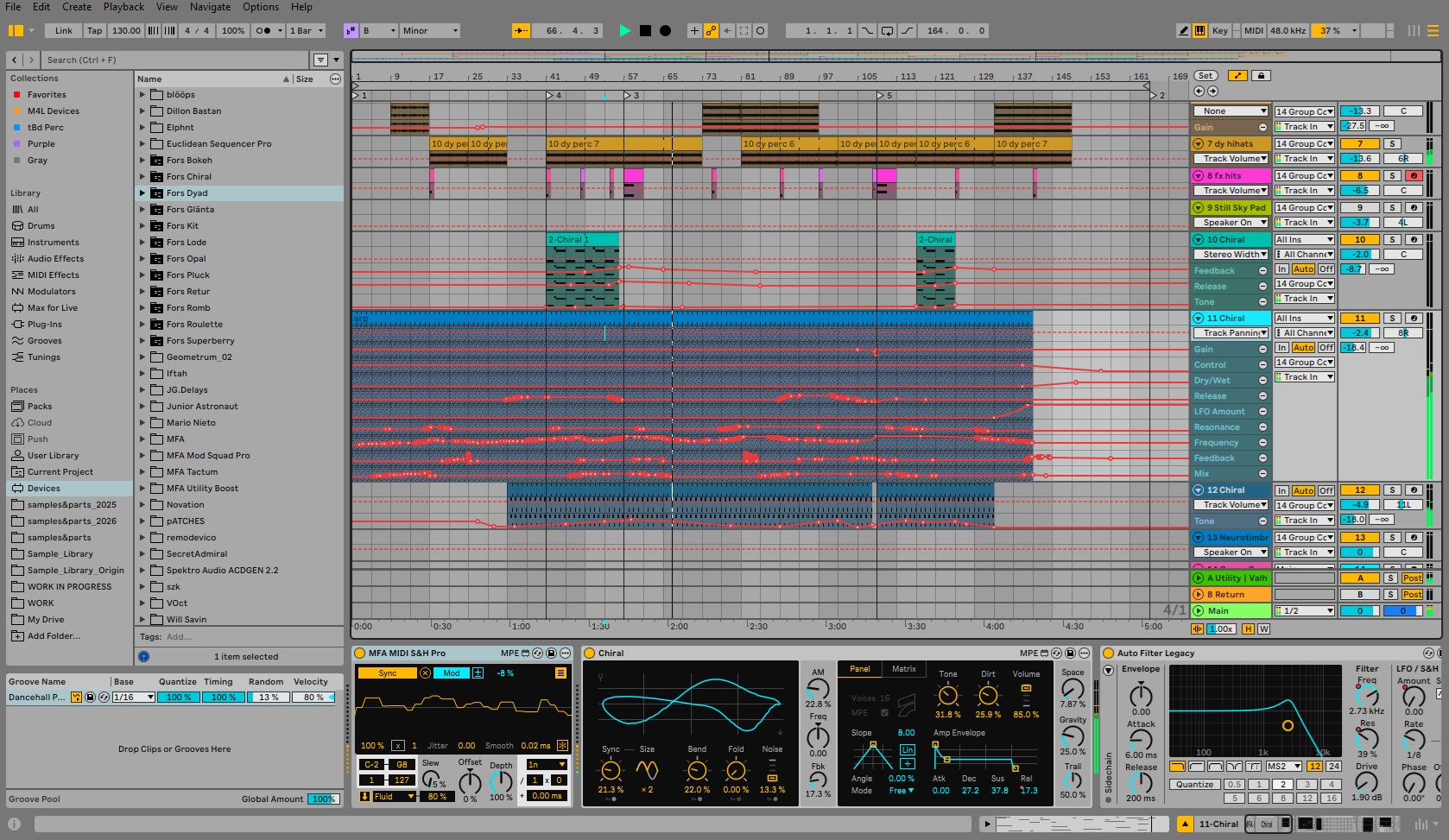
Many thanks for sharing the project file for the track They Came From My Head. Did that set the tone for the LP in some way?
It’s the opening track on the LP, so it does set the energy and tone going forward, and it was slightly unusual in that it was actually written, arranged and produced almost entirely in Ableton. Some of the initial patterns were done remotely on a laptop, so it started in the box and only features a few drum machine samples, which is why there were originally so many Max for Live plugins.
Initially, we’re always looking for some little thing that piques our interest, which could be a loop, arpeggio or bass line and that becomes the focus even if you might end up switching that off to develop a track in a different direction. On They Came from My Head, that spark came from Fors’ Chiral synth, which is a Max for Live plugin. It’s quite a complex little arp that acts as a rolling one-bar loop all the way through the track, and then we built secondary layers on top and everything evolved around that.
Download The Black Dog’s “They Came From My Head” Ableton Live Set for free
*Requires Live 12 Suite
Notes on the making of “They Came From My Head”:
This track uses largely stock Ableton Live and Max for Live devices. Many of the other tunes tend to use stems and samples recorded from hardware in improvised sessions, so the actual project files don’t have a lot to see. This is still a pretty simple project, with a lot of the progression and movement performed through automation, particularly on “8 Chiral Keys”, which runs through the majority of the track.
The initial demo was jammed live, with additional automation added later when it was mixed down for the album. A lot of the tracks on Loud Ambient are constructed around the idea of simplified instrumentation and live jamming, where we try to get the initial sound selection and balance right in the early demos. This means that we’re doing far less “fiddling” and correction in post-production and mixdown, so there probably aren’t many gimmicks or clever tricks in here.
The percussion parts were originally sequenced and then bounced from the Fors Dyad Max for Live device. I’ve no idea how we made the kick pattern though! Tracks 2, 3 and 4 all use Align and Utility to create a stereo effect in mono recordings. This was done on quite a few tracks across the album, as a lot of the original percussion came from mono sources.
When a second EQ is in a channel, this was probably added later during mixdown, after the initial demo was produced. They generally exist as a quick way to refine the final balance. 5 has spot effects in a Drum Rack and each sample has some Max for Live effects embedded alongside it. “6 Itchy Sub” is actually a Meld preset that may have been tweaked a bit, but it was pretty much what was needed to fill that role and we’re not precious about using presets if they perform the job required.
Tracks 7, 8 and 9 all use instances of the Chiral Max for Live device by Fors, again. No, we’re not sponsored by Fors, but we have used a lot of their plugins on these tracks. These three channels cover the rolling arpeggio keys and two lead parts, and make up most of the melodic content in the track. Track 8 has the most automation and also uses Expression Control to randomise the sync and tone of the arpeggio keys. There’s a dedicated delay that’s automated for some big feedback FX. This was originally Valhalla Delay, but has been swapped out for the stock Echo effect. The original VST is still there and should work if you have it installed.
Track 9 is a very simple key line with another Valhalla Delay, again swapped out for the stock Echo effect.
Track 10 is acting as a bus group, pushing most of the instruments first through the glue compressor, and then through a second compressor providing ducking on a sidechain from the kick.
There’s just one return channel for the shared reverb effect, originally using Valhalla Vintage Verb with a 3.4s Concert Hall effect, but we’ve added a Hybrid Reverb as an alternative. On the master channel, we’ve got automation on an Auto Filter handling the DJ drop effects, and then a few plug-ins for finalising the output (ELPHNT Excite and Widen, EQ8, Compression, Multiband and Limiter). These weren’t in the original project, as this refinement is usually completed together with the other album tracks to help with consistency.
Is your motivation for building something in Max for Live usually to fix a problem or are you more inclined to use it as part of an explorative process?
It's nice to explore, but we’re generally looking to solve a problem. These days, more often than not, someone else has already solved that problem for you, but at the same time I've got into plug-ins that other people have built and thought they were going to be rubbish, only to find they’d put a really nice reverb on the end that I can hack and reuse.
“The tool we always go back to is Simpler. It's such a workhorse that I don't even bother switching out to Sampler a lot of the time.”
I have to say, even though I've got a bit of a programming background, I'm not very good at using Max itself. I don't know all the functions to build serious projects from scratch; I just keep poking at it. If there's another tool that does the job, we're not going to sit there all afternoon trying to wire up various patches to make it work. I think that's why we've never really got into the modular stuff – as fascinating as some of those devices are, you can spend hours cobbling things together just to get a fart sound.
Are you using Ableton synths like Operator or Wavetable much?
We’ve used Wavetable quite a lot because, compared to a lot of the wavetable synths I’ve used, it's very simple with the two waveforms that blend and modulate against each other. You can also attach an external modulator and hook that in if you want to go bonkers, but the tool we always go back to is Simpler. It's such a workhorse that I don't even bother switching out to Sampler a lot of the time.
Simpler’s great for when you want a MIDI part but a sound isn't there, or you’re looking to take a fragment of sound from a sample of a piece of hardware and don't want the pattern from the original loop. We can just grab that sound and have it open, working and playable within a few seconds.