Artists
Downloads
Jul 29, 2026
Late Bush: Breaking and Remaking Baroque

Music from the Baroque period survives mostly as written scores rather than recordings, making every performance an imaginative process – this idea shapes Hoarses, the new album by Brussels-based composer-producer Pierre Dozin. Recording as Late Bush, Dozin blends early classical music with electronics, power ambient, IDM and avant-pop, combining AI voices with strings performed by orchestral ensemble Echo Collective to blur the boundaries between human and artificial, acoustic and digital.
What are you sharing with us today?
“I’m sharing a sound pack made from material from my album Hoarses. It contains bass sounds, drum fragments, vocals and atmospheres taken from several tracks, some of which have been reprocessed. They’re intended as raw material ‘rushes’ and represent my way of reclaiming and repurposing created material.”
“Rather than present a neutral sound bank, I wanted to share material that’s already musically and emotionally charged and representative of the elements that can be found in my tracks. It’s kind of like an abstract construction kit. The pack’s not tied to a single track; I just went through the album and extracted some varied material from it.”
The album concept
“One of the ideas behind Hoarses is that we can never know exactly what Baroque music sounded like when it was first performed. The music itself has disappeared and only the written scores remain, which means that every modern performance is essentially a reconstruction.”
“Beyond its value as a creative tool, using AI-cloned voices interested me conceptually because they extend that same idea: reconstructing something that no longer exists. The voices feel spectral and unstable, existing somewhere between memory and simulation. By contrast, the live strings recorded with Echo Collective bring something physical, human and tangible.”
Why Ableton?
“I chose Ableton because I find the software to be quite an open environment. With Max for Live, and more recently, Extensions, I can build tools that fit my specific workflow for composition, sound design and live work, including audio-visual installations. As a sound engineer, I often work in quite rigid environments, but Ableton allows me to create more open, experimental and direct sound architectures.”
Daily workflow
“I use Ableton for production and research. For example, right now I'm developing an Extension for melodic and harmonic MIDI counterpoint based on my own musical vocabulary alongside a Max for Live tool for real-time MIDI mutations.”
“With Max for Live, and more recently, Extensions, I can build tools that fit my specific workflow for composition, sound design and live work, including audio-visual installations.”
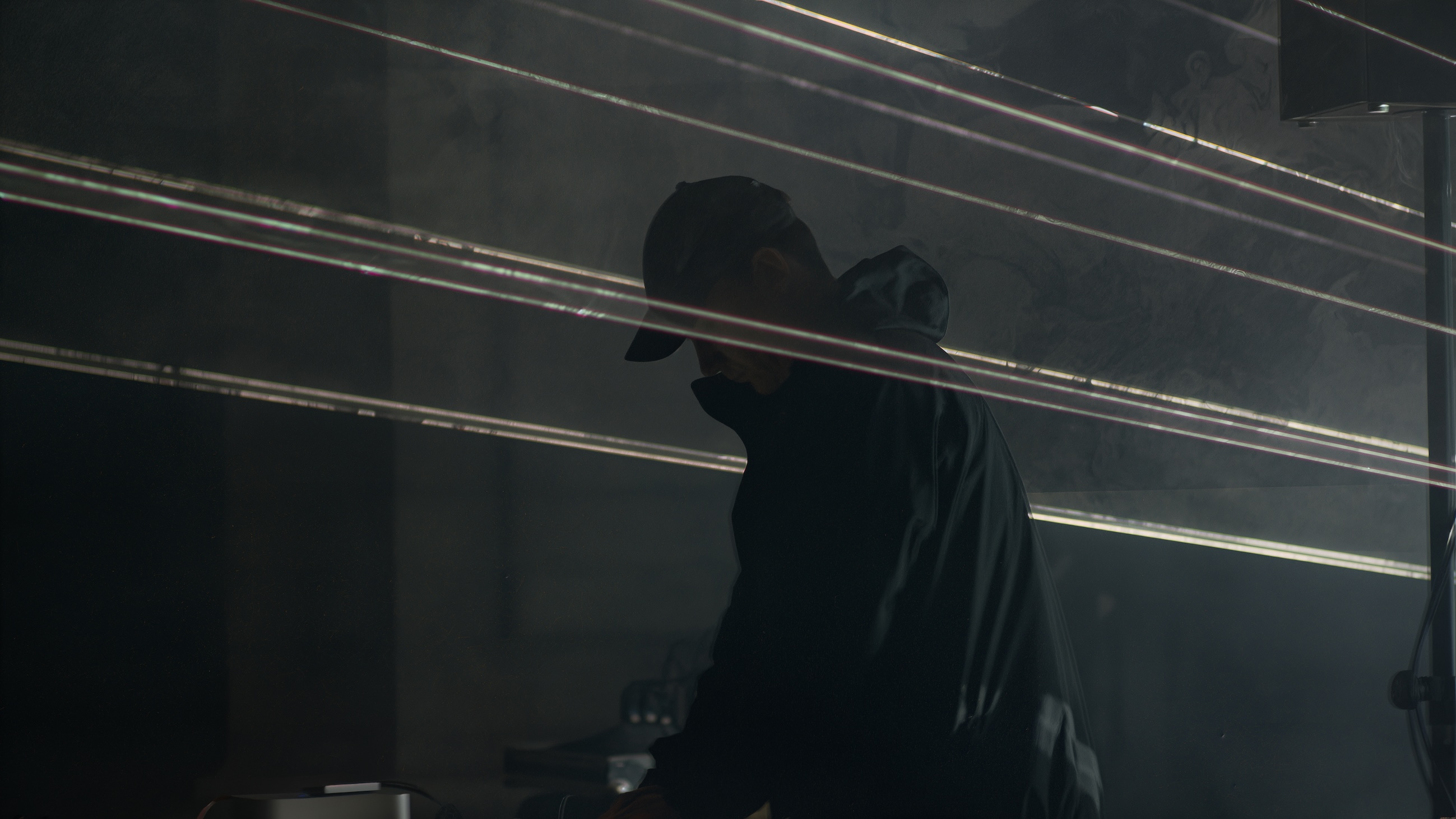
“For live work, I’ve been using Ableton in my performances for 20 years. For the Hoarses live show, I have two computers running together: one for electronics and the other for processing Echo Collective’s strings with granular and distortion effects.”
Spatialisation
“A good example of how I use Ableton in a live environment was Aline Bouvy's La Merde installation, presented at the Luxembourg Pavilion at the 61st Venice Art Biennale. At the show, I used it with Max for Live alongside 4DSOUND's spatial audio engine to create the music and sound design for a 9.1.6 immersive installation, where all of the sound was edited directly to picture.”
“The system runs in real-time, synchronised with the film, while a second audio computer plays a Dolby Atmos re-render. 4DSOUND spatialises the audio in real-time, but each playback produces a different spatial configuration through the engine and round-robin sample playback, meaning each screening produces a different spatial mix.”