Artists
Apr 22, 2026
Grand River: Building a Symphony for Endangered Birds

In our busy, day-to-day lives, it’s easy to take the sounds of nature around us for granted – the rustle of leaves, the wind moving through the trees, birdsong in the early morning. Yet when we slow down and truly listen, these familiar sounds reveal a fragile beauty: a reminder of how deeply our lives are interwoven with the natural world.
Composer and sound artist Aimée Portioli – known on stage as Grand River – understands this intimately. Nature has long been a grounding force in her work, inspiring compositions that blur the boundaries between the organic and the electronic, the external and the inner world. Her composition Tuning the Wind, for example, transformed field recordings of air currents into a prepared instrument, establishing a dialogue between the elements and the listener – a sensibility she continues to deepen in her subsequent work.
This attentiveness to sound goes beyond aesthetics; it reflects Portioli’s belief in music’s psychological and communicative power. She explored this theme in her academic thesis and continues to pursue it through her practice, often returning to the question of how music can bridge personal experience and collective understanding.
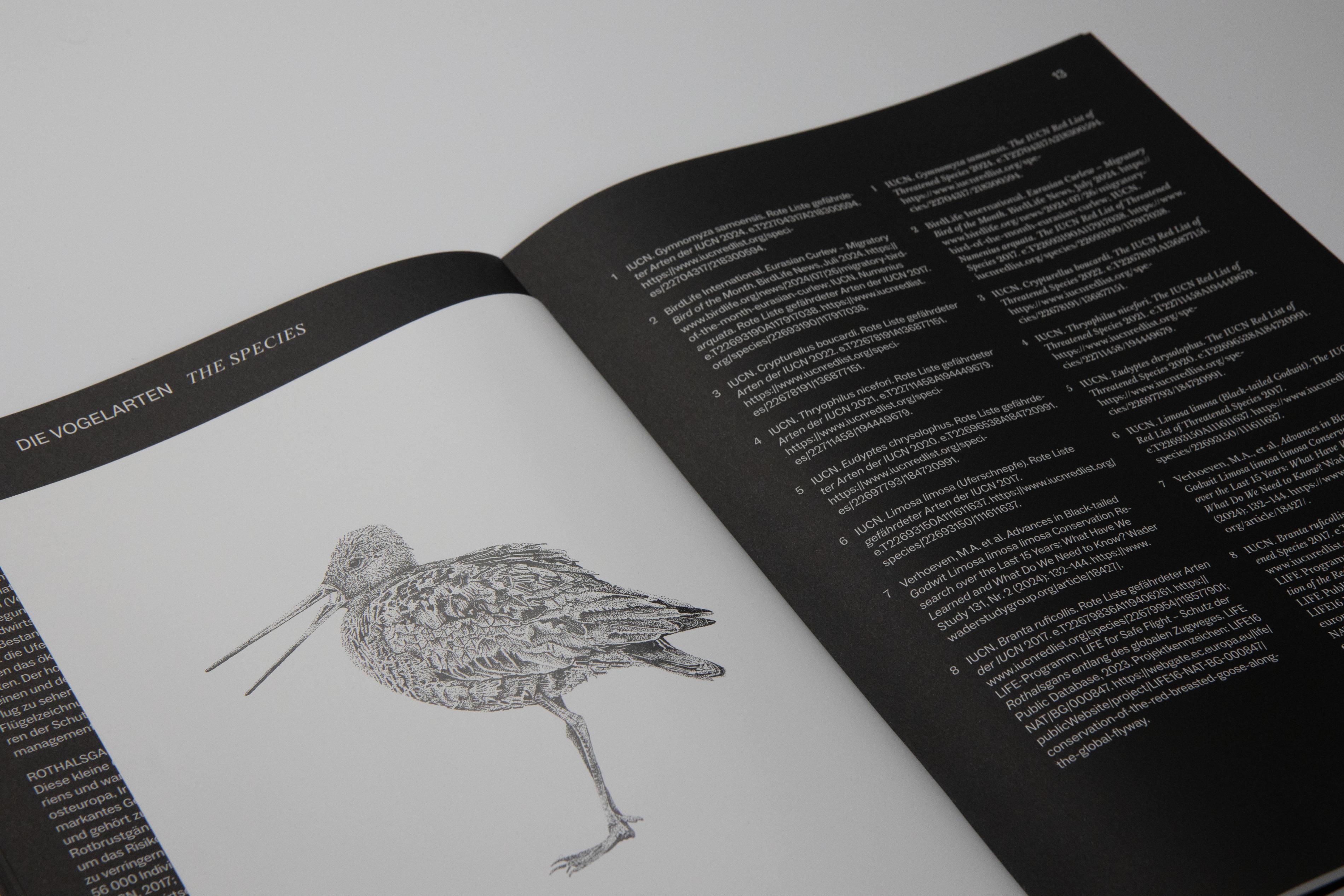
Portioli’s inquiry finds new form in her latest installation, Symphony for Endangered Birds, first staged at Museum Folkwang in Essen. The 28-minute, seven-channel composition merges field recordings of endangered bird species with spatial sound design and electronic music, while a feather sculpture by Federico Gargaglione and a booklet with bird illustrations by Brandon Locher provide visual anchors to the exhibit.
We recently spoke with Portioli about the conceptual foundations and technical processes that shaped Symphony for Endangered Birds. Alongside a short film documenting the installation’s setup below, the following conversation offers a deeper insight into her practice and the ideas that brought this project to life.

Hi Aimée. For readers new to your work, how did you find your way into music making?
I connected with sound and music very young. I started singing in a children’s choir in the Netherlands. We traveled, performed in churches, cathedrals, and concert halls. There was a band accompanying us. I loved being on stage and working with other people.
From there, I wanted to learn instruments. For the first 15 –16 years of my life, I was mainly singing, playing guitar, and songwriting. I played in bands. Then I picked up the piano, and later some cello.
When I wanted to start recording my own songs, I initially used a tape recorder. Later, I started recording in a DAW, using my parents’ computer. I recorded guitar and voice, then discovered effects, other sounds, and audio editing. That’s where my interest in electronic music began – merging acoustic elements with electronic ones.
Your academic thesis on the psychological and communicative function of music sounds fascinating. How does this study influence your work today?
My thesis explored how sound and music can subvert images and how strongly they influence us psychologically and emotionally. I wrote it in my early 20s, but the theme still runs through my work. When you add sound or music to a piece that aims to create awareness, you’re communicating on an emotional level. Facts, texts, and numbers don’t speak to us in the same way.
You’ve recently been applying your ideas in ways that link music with ecological awareness. Could you explain how this comes through in your work?
I’m very drawn to nature. It’s not only an escape; when I’m in nature I can detach and think about what matters. It’s a necessity for me to spend time in nature, it encourages me to listen: the wind, birds, the leaves. It’s calming, hypnotic, and fascinating.
At some point, I wanted to integrate more field recordings into my work. I’d already used my own recordings – birds, sea, ambient sounds – in tracks on my albums. Then I made a piece called Tuning the Wind, initially a sound installation merging wind recordings with composition. That was a turning point: wind became the protagonist.
How did Symphony for Endangered Birds first begin to take shape?
After Tuning the Wind, I wanted to create a new piece, again, working with natural elements. I’ve always been drawn to birdsong. In Berlin, in May, you hear nightingales in the evening. I used to walk my dog at night, and we’d listen to them. I began recording them and got curious about birdsong in general – noticing timbres, pitch changes, vocalizations. Naturally, I wanted to make a piece incorporating them.
I asked: which birds should I include? I decided to focus on endangered birds – species you won’t usually hear walking down the street – to give space to voices that aren’t normally heard. I wrote the concept and proposed it to Museum Folkwang; they liked it and commissioned it. Then began a long research period, followed by the creative and technical work.
The project is as much about physical space as it is sound. How closely were you involved in designing the spatial experience?
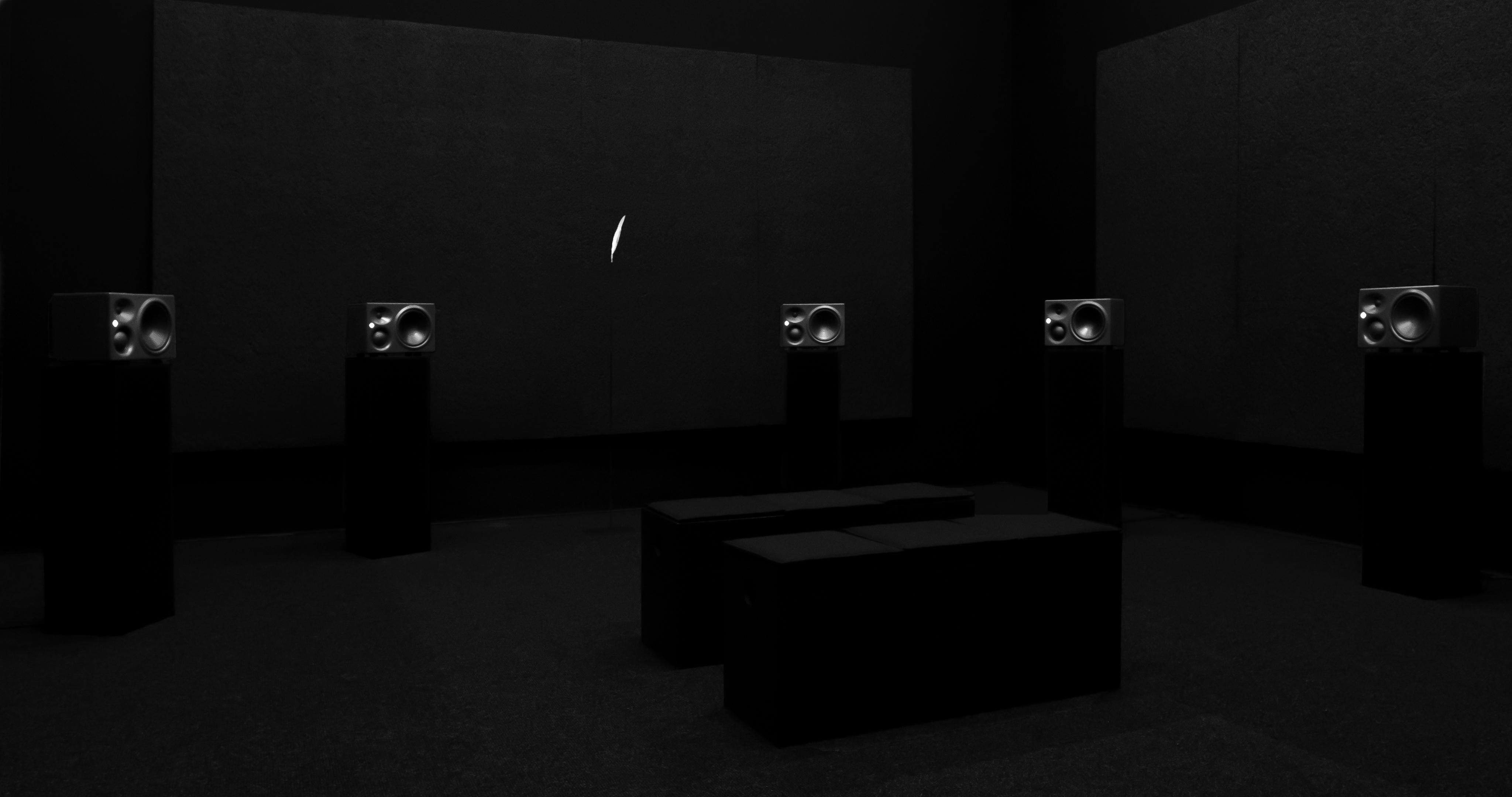
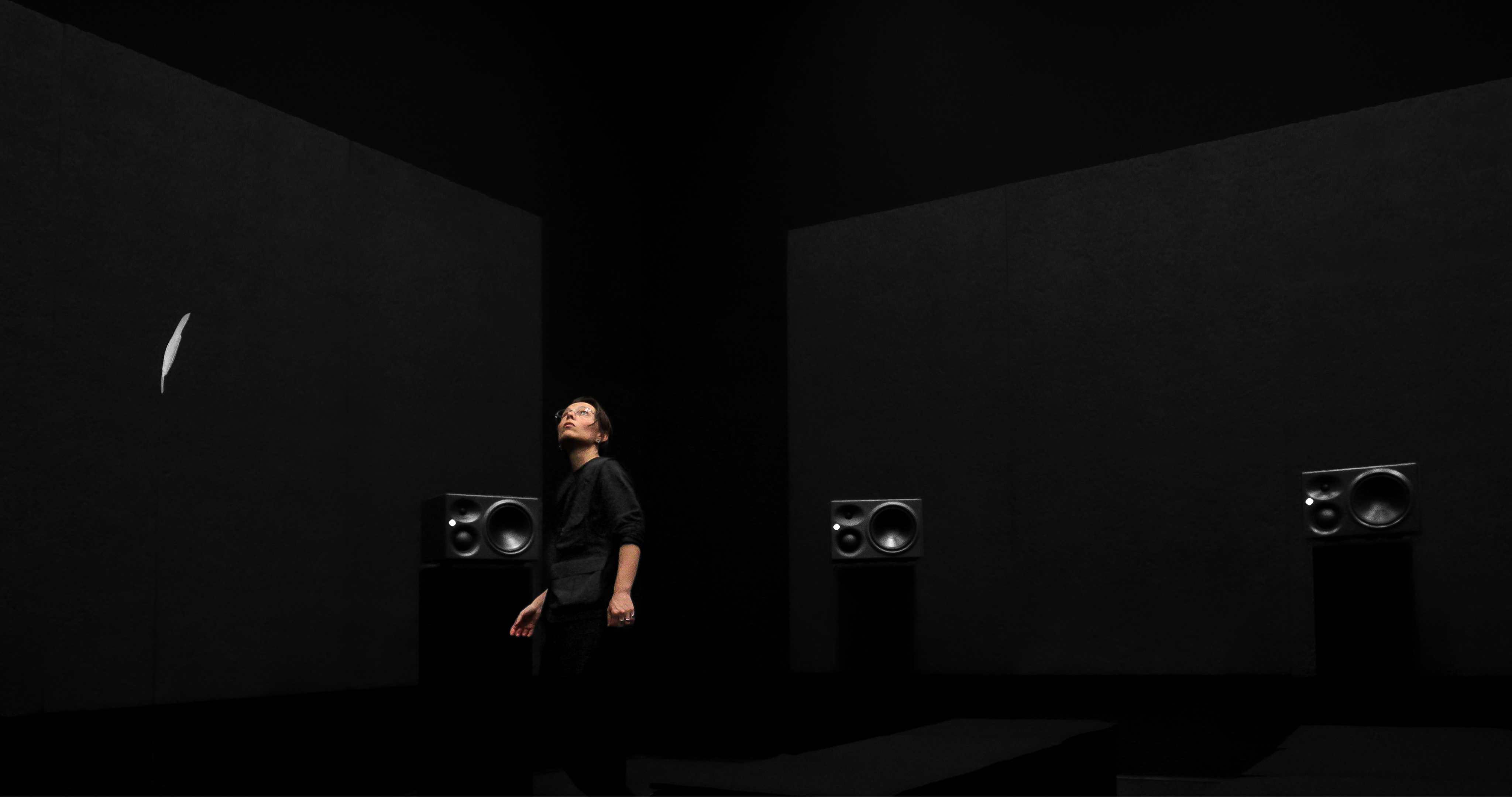
I designed the room myself, working closely with collaborators. I wanted the space to be very dark, creating an immersive listening environment with minimal visual distraction and a strong contrast to the outside world. The darkness can feel slightly uncomfortable – intentionally so – as it sharpens focus. A light artist assisted in positioning and designing the directional ceiling spots to shape the atmosphere of the space.
Federico Gargaglione created the sculptural feather that serves as a visual focal point within the installation, embodying themes of vulnerability and quiet endurance.
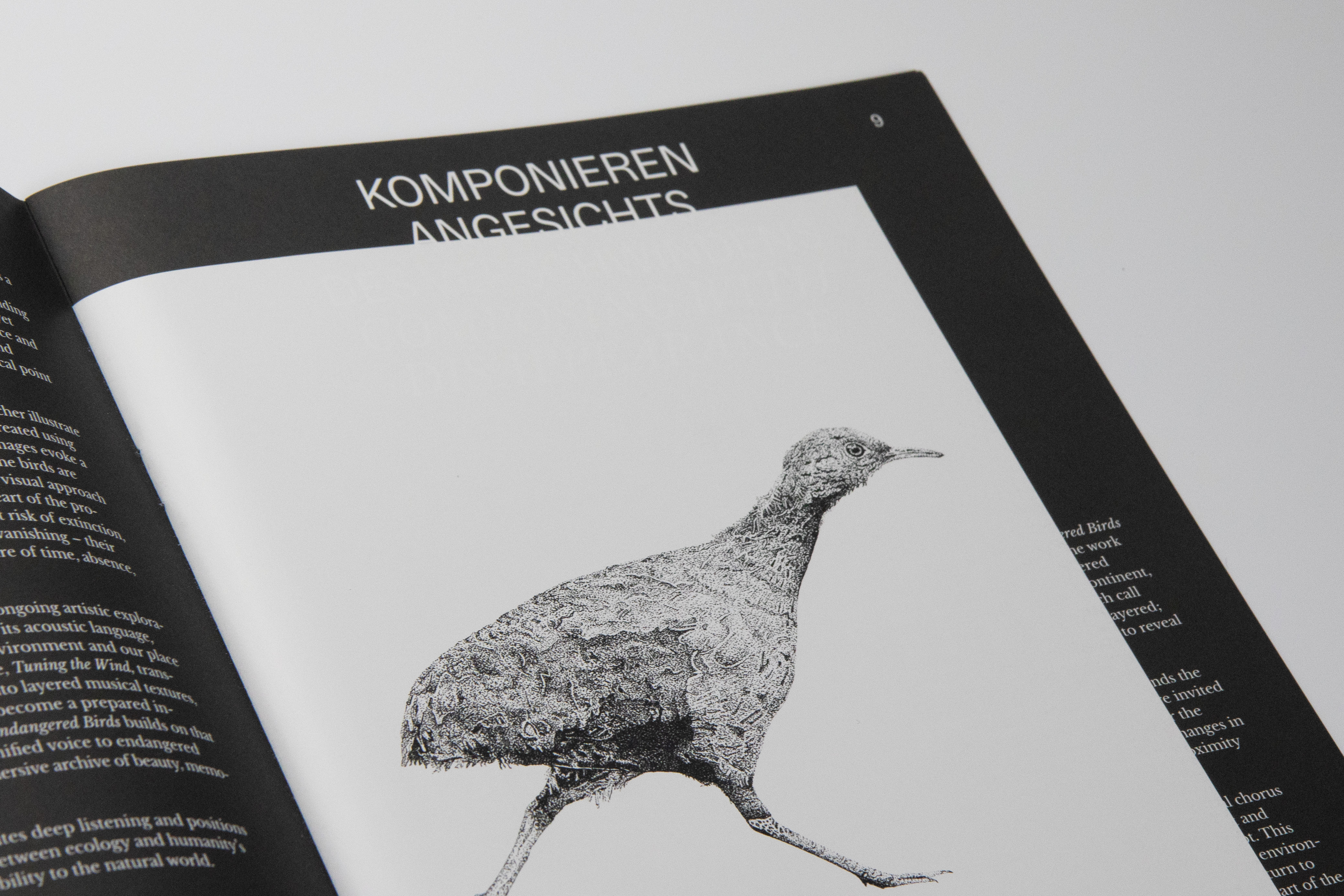
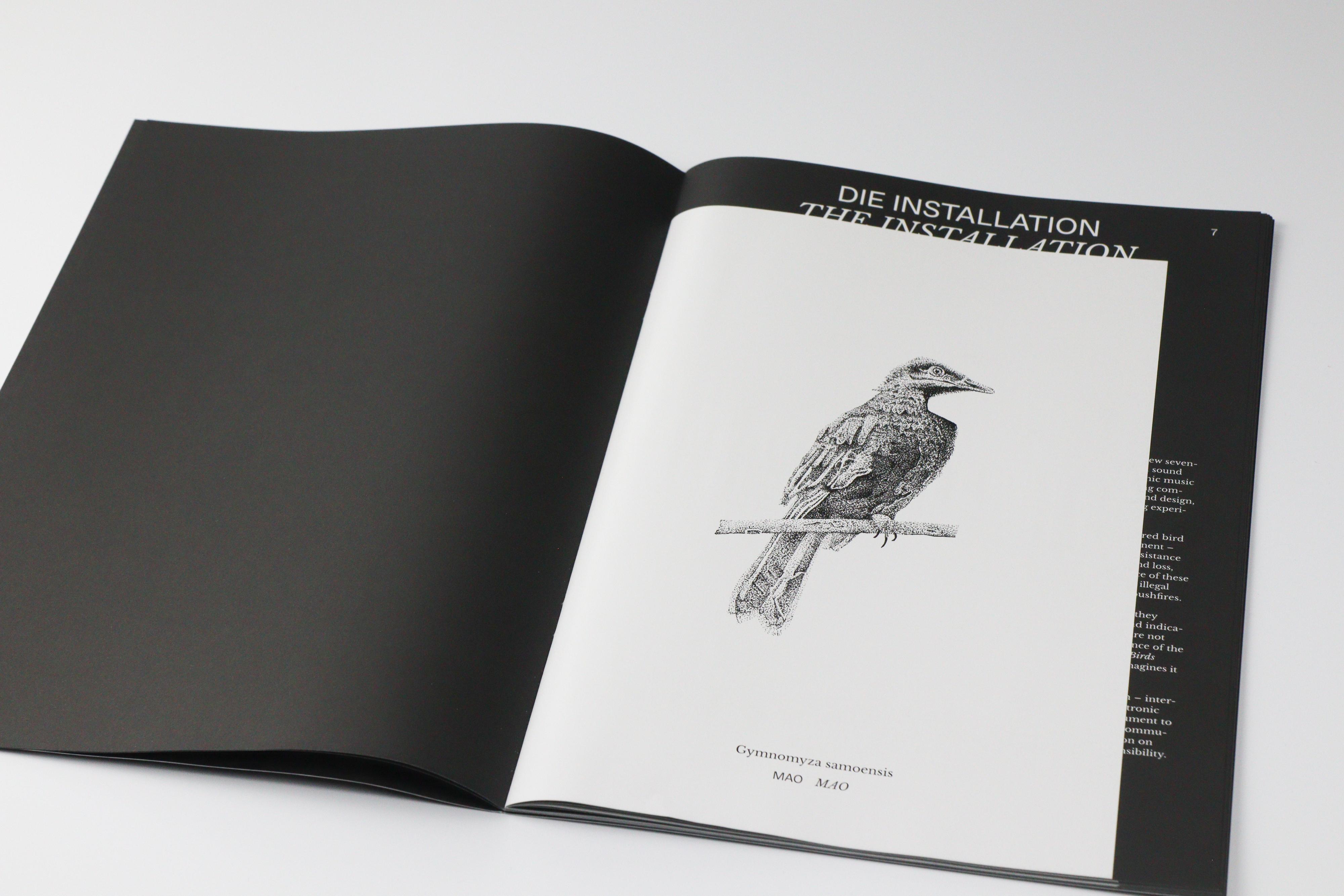
Brandon Locher produced illustrations of each endangered bird featured in the work; these appear in an accompanying booklet designed by smile. Visuelle Kommunikation, with texts by Peter Daners and me.
How did you decide on which species of birds to feature the final piece?
There’s a portal called the IUCN Red List, where I began researching the endangerment status of various bird species. Their classification shifts over the years.
There are seven bird species in the final piece, each representing one of the world’s continents.
I worked with field recordists and archives, because these birds are too rare to record easily – in some cases, there are only a few hundred left in the wild. I selected the recordings based on their quality, length, and timbre. That became the foundation of the work.
Throughout the composition, do you move linearly through each continent, or do you interweave them?
They’re interwoven. The piece starts with the Macaroni Penguin from Antarctica dialoguing with the Tinamou. There’s no order of preference or geography – just what serves the story. In the museum’s seven-speaker setup, you hear them spatialized – the penguin from one side, the Tinamou from another, moving slowly through the space.
How did the birdsongs help you decide on the musical direction to accompany them?
I first researched and gathered birdsong recordings. Selecting seven wasn’t easy. After choosing, I listened carefully and asked: What emotion or instrumental timbre would fit each bird? Timbre is key for me. There are so many acoustic and electronic timbres that evoke different emotions. The birds’ timbres guided my instrument choices. The birds came first; composition and narrative came after.
I built the music around them and tried to be respectful to the recordings. I always keep clean recordings present. Sometimes I also manipulate them – but even then, the clean take is there alongside the processed one. For example, with the Mao, representing Oceania, I stretched it, ran it through Granulator, and created what I call the “Mao’s cry,” a dramatic, important moment leading to the rupture in the middle.
What happens at this point of rupture?
In the middle of the composition, you hear the sound of trees being cut and falling. It’s also spatialized, so in the museum you hear one tree to the left, one behind you, then one falling directly in the center. After that comes silence.
It’s both metaphor and reality. Deforestation is one of the major threats these species face, though there are others – wildfires, urbanisation, wildlife trade. I wanted to interrupt the flow, to create a moment where listeners are forced into reflection. Then the piece rebuilds in a different way.
After the rupture in the middle, the birds reappear but altered: gated, stuttering, as if their world has become unstable. That was important symbolically, but also musically – it set up space for instruments to enter.
In the second half of the piece, as it becomes more melodic, what instruments and production techniques come into play?
There’s three main elements: clean bird recordings, manipulated bird recordings, and musical composition performed by me. For manipulation, I used granulation, filtering, EQ, reverb, echo/delay. I often use Ableton’s built-in reverbs and delays. I also use Guitar Rig (Native Instruments) on many sources.
There’s a tool I used called SpaceBlender (from Soundtoys) to create drone-like textures from birds – I’d layer the clean recording with a filtered “space-blended” version for atmosphere. I also used PaulXStretch. Hardware-wise, after the rupture you hear the Prophet Rev2 (Sequential).
Toward the end, the Prophet returns and is passed through a Roland Space Echo. I also used an Eventide Ultra-Harmonizer. Another synth used is the Roland SH-10, but the Prophet plays a big role in the second half.
Mixing – EQ, reverb, compression – is part of my composition process also. I don’t save mixing for the end; it’s how I give things space.
You had a seven-channel speaker array in the museum. How did you prepare that in your studio?
Sometimes I worked in a Berlin-based studio with an eight-channel setup (I used seven). I initially composed in stereo, knowing I’d spatialize later, but moving from idea to execution is a big shift. When I brought my Ableton project and stems in, it was eye-opening – introducing space changes everything, and you must revisit decisions to give “space” its due.
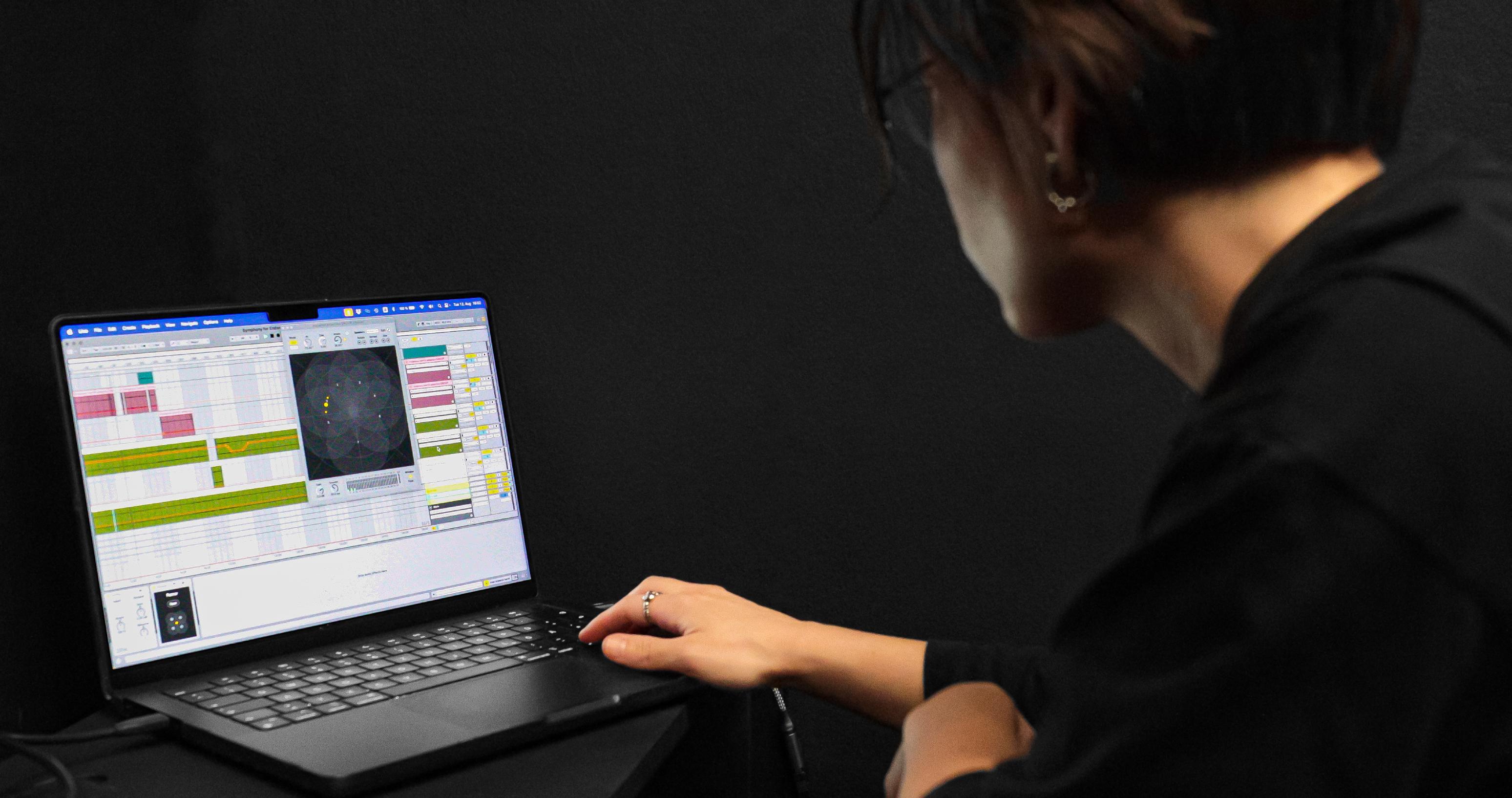
I later set up seven speakers in my own studio, placed to match the museum layout, to refine the spatialization. I did composition and spatialization entirely in Ableton Live using a Max for Live device called Panner, from the Audio Routes pack.
I routed Panner to four return tracks (covering channels 1–6) plus a 7th mono channel, exported each return separately, assembled them in Audacity, and exported them as one multichannel file.
That multichannel file runs on a dedicated audio player (WavePlayer8) in the museum, looping all day into a DI and the speaker system.
What speakers did you choose for the installation?
Seven Neumann KH 310 A. They sound fantastic – pristine, clear, clean. With the acoustic wall panels and carpet flooring, the sound was really good. I was worried during an earlier site visit – the room was very reverberant – but with treatment and these speakers, it worked beautifully. Neumann collaborated on the speakers; the panels were provided by Sealed Air (“Whisper” panels). The room is completely blacked out; only the speakers, the sculpture, and the seating area are lit, so the speakers become visual protagonists too.
How did audiences respond?
At the opening, the room was packed. People queued to enter, which made it more social than contemplative. But the next day I watched visitors sit quietly, take the booklet, and stay through full cycles.
A journalist came for an interview. She only had time for half the piece, but once it began she insisted on hearing it all. She said she had goosebumps. It was one of my first times sharing the piece in that space. Composing is solitary, but that shared moment was very beautiful.
What do you hope listeners take away?
Awareness and curiosity. Most of us don’t know the birds or even the trees around us. These species are fragile, and some may disappear completely. Their songs carry that fragility. I wanted to treat them with respect, to give them presence, and to create space for reflection.
And looking forward, what's on the horizon?
I hope to tour the installation; it can adapt to different rooms and systems. I’ll continue to explore the human–nature relationship through sound, but I also have another installation in mind not based on natural sources.
On the concert side, I'm touring In uno spazio immenso with Abul Mogard, and at the end of 2026, I have a new album coming out.
Keep up with Grand River on Instagram, Bandcamp and her website
Text and interview by Joseph S. Joyce
Photography by Alejandro Sandoval Bertín & Philipp Bückle
Video production by IMAWA Productions
Filming & editing by Alejandro Sandoval Bertín
Illustrations by Brandon Locher