Artists
Dec 23, 2025
Christopher Willits: Development & Envelopment
Composer, guitarist and visual artist Christopher Willits works at the intersection of sound, technology and mindfulness. Having released on the Ghostly International label since the early ‘00s, the influential ambient producer has spent the past two decades expanding how we experience music and space – blending guitar textures with intricate electronic processing to create immersive, emotionally resonant soundscapes.
Born in Kansas City, Missouri, Willits traded his love of sports for the expressive freedom of playing guitar, leading him to Mills College, California, where he studied electronic music with luminaries Fred Frith and Pauline Oliveros. There, he began developing his signature technique of ‘folding’ - a process of live resampling and reshaping sound designed to blur the boundaries between composition and improvisation.
Willits’ latest album, New Moon, dedicated to late collaborator Ryuichi Sakamoto, distills his lifelong exploration of presence, sound and connection into its purest form, inviting the listener to pause and find light through listening. Willits is also the co-founder and director of Envelop, a non-profit dedicated to building community through immersive audio spaces and open-source spatial sound tools, including Envelop for Live, a Max for Live toolset created for spatial audio processing.

Christopher Willits - “Observe”
Your approach to guitar has always been experimental. Once you’d attained the instrument, were you quick to pick up on creating customised effects?
From really early on I was playing with all kinds of music and equally influenced by jazz, blues and soul, alongside everything that was going on in the early ‘90s with noise, grunge and electronic music. I'd play the blues or figure out John Coltrane and Hendrix solos, but I'd also be running tons of distortion, reverb and delays through my guitar. From an early age, I was really attracted to sound and how that became music, and that was something that became clearer during my work with Ryuichi Sakamoto. I think that’s why we gravitated to each other - we saw music as sound, not some specific genre.
When did you first come across Ryuichi Sakamoto?
There was a project called Chain Music that Sakamoto started as this exquisite corpse-type idea, where artists would send whatever they did to another artist to remix. My friend Taylor Deupree, who invited me to release music on 12k in 2002, finished one of these Chain Music pieces, sent it to me and I completely changed up the direction of this collaborative remixing project and made it into a meditative ambient piece. Right after I sent it back to Sakamoto, he reached out and asked, “Do you meditate? I love the direction that you took this.” Meditation is a big part of my process; it helps me stay grounded and opens my heart to all the possibilities in sound, music and life in general, so our first conversations were about meditation and music, and soon after he asked if I’d like to hang out in the studio to see what happens.
How did that turn out?
Our first studio session became the album Ocean Fire. We jammed for hours, completely lost track of time and had this beautiful sonic and musical telepathy. From there, we felt a spark that we should continue and on our second album, Ancient Future, decided to create a style of ambient jazz that we hadn't heard before. He was improvising piano progressions and I was creating guitar lines and textures that influenced other piano motifs. After going back and forth remotely, we’d then adjust the mixing and final layering in the studio.
You’ve dedicated your latest LP, New Moon, to Sakamoto. Is that purely as a mark of respect, or is the album in some way an extension of his philosophy or sound principles?
So much love and respect - when he passed a couple years ago, it was really profound. All of the things we’d learned together came rushing back into the void of his departure, and all the gifts and lessons hit me on a deeper level while the album was starting to emerge. There are so many layers to the concept of New Moon, but his passing also connects to the mortality of my mother. She'd been struggling with Alzheimer's for a number of years and there have been so many ‘beginnings’ happening in my world, but yes, New Moon is the first album I've made since Ryuichi’s passing, so it was obvious to me to dedicate it as a thank you to him and the music we created.
You were around 10 years into your career when you began working with Sakamoto. By that point, were you already using Ableton as a compositional tool?
I started using Ableton Live seriously in 2004. Since the late ‘90s, I’d been using Max/MSP for guitar processing and began converting the patches into Pluggo plugins. Moving into the 2010s and Ableton Live’s integration of Max for Live was a dream come true because I no longer had to bake everything into custom VSTs. I could have a living Max for Live device that I’d open whenever I needed to, tweak things and keep the device development closer to the creative process. So for me, Ableton Live has been the best tool ever, and I’m super grateful that it exists and continues to keep growing and evolving.
In what way did you find Ableton, or Max for Live, specifically, an important tool that could enable you to creatively expand your approach to guitar?
When I started using Live, it was amazing because I didn’t have to reinvent the wheel. Previously, I was making my own Max/MSP looping and processing systems, but now I could do all of the custom guitar processing in Max for Live combined with full DAW functionality. It allowed me to focus more on the sound and music and less on developing my own looping tools. This opened up a huge creative space because I suddenly had everything I needed in one place and was able to integrate the technical and creative into one flow. My process has always been very live - I’m composing and improvising, so Ableton Live has been more like an instrument than a DAW, giving me so much creative freedom.

Christopher Willits in the studio
One of your techniques is called ‘folding’, where guitar lines and harmonies are folded into each other using custom-designed software. Can you explain that a little?
Folding is non-linear looping that I improvise with and was the main guitar processing and sound that I explored in the late ‘90s and early ‘00s. Essentially, it's delay lines and granulation techniques that allow live guitar to move within constrained yet indeterminate positions in time. In early solo albums like Pollen, I was improvising with granular synthesis and delay lines that were reintroducing what I played from the past into the present, which is why I call it folding. It’s all about emergent patterns through generative processing to create systems for improvisation.
How does Max for Live assist in that area?
Max for Live allows me to create systems for processing in real-time, so the creation of sound and the development of tools are more closely connected. Working with Mark Slee and Roddy Lindsay on E4L (Envelop for Live), which is using Max for Live, is the main processing focus for me right now. We love finding new ways for spatial audio to become more of a compositional process and less of a post-production afterthought.

An introduction to Envelop for Live
Before we discuss the genesis of Envelop, what is it about immersive music that you find important, satisfying, or acts as a catalyst for your creativity?
Music is a language of the spirit - a universal vibration, and when we create it that vibration has a physical effect on a deep emotional level. When I can create sound designed for a three-dimensional experience, I feel it takes me even deeper into that emotional space. It physically creates space within the composition and arrangement of the music, and that inspires how I compose and position the layers of the music. In terms of mixing, everything I know about mono and stereo production holds true, but I have so much more space to explore, both horizontally and vertically. I listen to the world around me in at least three dimensions, so creating music that is intentionally composed and mixed for 3D space feels more natural to me.
New Moon is certainly a gorgeous album where the guitar and synths sound almost indivisible, or maybe interchangeable in some way. With that in mind, do you have a singular creative source?
Almost everything I create starts with guitar, based on a melody line, chord melody or progression. I love the guitar because it’s a portable orchestra - I can play individual lines, like a horn, or chords like a piano, and no matter how I’m processing it there’s this warm organic string vibration at the foundation. The way I'm swelling and processing the guitar can sometimes sound synth-like to people, but in terms of New Moon, I often layer other types of high or low synths and field recordings that move above and below the guitar’s frequency spectrum. So the guitar holds the centre of it, including vocal layers, and then the synths are shimmering above that or holding down the bass along with some bass guitar.
How does Ambisonic sound play into the spatial universe that you're operating in?
Ambisonics is an open-source immersive audio format that’s completely scalable. Anything you mix can be played on any number of speakers or headphones, and you can convert an Ambisonic mix into a distributed immersive audio format. This open and non-corporate-owned format made complete sense for Envelop to use as the foundation for E4L because we wanted to create accessible non-profit tools that will benefit artists now and into the future. Different proprietary formats for immersive audio/spatial audio may come and go, but Ambisonics will always be around with an active open-source community continuously working with it.
“I listen to the world around me in at least three dimensions, so creating music that is intentionally composed and mixed for 3D space feels more natural to me.”
Tell us more about the origins of Envelop?
I've always been fascinated by immersive sound, going back to the late ‘90s when I was playing with quad and 5.1 sound installations at The Kansas City Art Institute. When I went to Mills College, Pauline Oliveros, who coined the term “deep listening”, was one of my teachers, so that was a real blessing, and working with her validated so many ideas I had around listening. During that whole period, I was playing ambient and experimental music in rooms where people were hanging out, drinking and socialising, which is totally cool, but I didn’t feel like the environments I was playing in were designed for any kind of deep listening experience. Then between 2003-04, during some of my first performances in Japan I experienced audiences that were listening on a much deeper level than I’d experienced in the US and Europe. So one of the biggest personal inspirations for Envelop was to create listening spaces that could better facilitate deep listening in general, and when thinking about that, the idea of immersive sound naturally arose since it allows us to listen to music in the same way that we listen to the world around us every day. As we were forming Envelop, it became clear that the vision was much more than providing technical solutions for spatial audio software and listening spaces. Those are the tools, but it’s really about connection, community, creativity, empathy, and inspiration. With that in mind, we felt the best business structure to hold the mission and vision was to become a non-profit and keep the tools free and open.
How did the project kick off?
Our first project was to create Ambisonic production tools that work with Ableton Live to make immersive music and deliver the sound experiences we were imagining. At the time, there were no flexible solutions, so this became the first iteration of E4L. Once the tools solidified, we focused on building a listening space, having no idea where it would live, and in perfect synchronicity our friend Jeff Whitmore reached out with an opportunity that became the physical space of Envelop SF.

Christopher Willits at Envelop SF
How has the E4L listening experience been progressing since then?
We opened our first listening space in 2017 and now, over eight years later, we’ve hosted thousands of events in San Francisco and built a mobile system that we've taken to festivals like FORM and FWB Fest, alongside other events. In 2018, thanks to our partners Greg Wood and Scott Wood, we opened a listening space in Salt Lake City called Envelop SLC, but then COVID happened and it wasn’t possible to keep the venue open. Gratefully, our supporters kept us alive through all of that, and although we had to scale back, we learned so much about how we could grow beyond SF. It’s all about the community of listeners, donors, artists and the team itself that makes it all possible. Our vision is to design and operate listening spaces all around the world so that more people can connect, feel the music on a deeper level, and provide artists with an opportunity to share their creativity in an intentional listening environment.
Does E4L have uses that go beyond performing in specific immersive audio environments?
We can support any immersive format, but E4L works seamlessly with Ableton Live Suite, so the majority of artists we work with love to have that compositional level of control in their live performances and DJ sets. You also don’t need multiple speakers to use E4L. It’s nice to have a minimum of 4 speakers, but E4L has binaural transcodes in the default output options, so you can prepare a set for an Envelop listening space, or some customised installation with any number of speakers, and still monitor everything in spatial audio, hearing the illusion of 3D sound on headphones. When you arrive at the venue, all you need to do is change the decoder and output settings and the virtual sphere of sound that you hear in headphones translates to multiple speakers.

Envelop for Live devices in Ableton Live
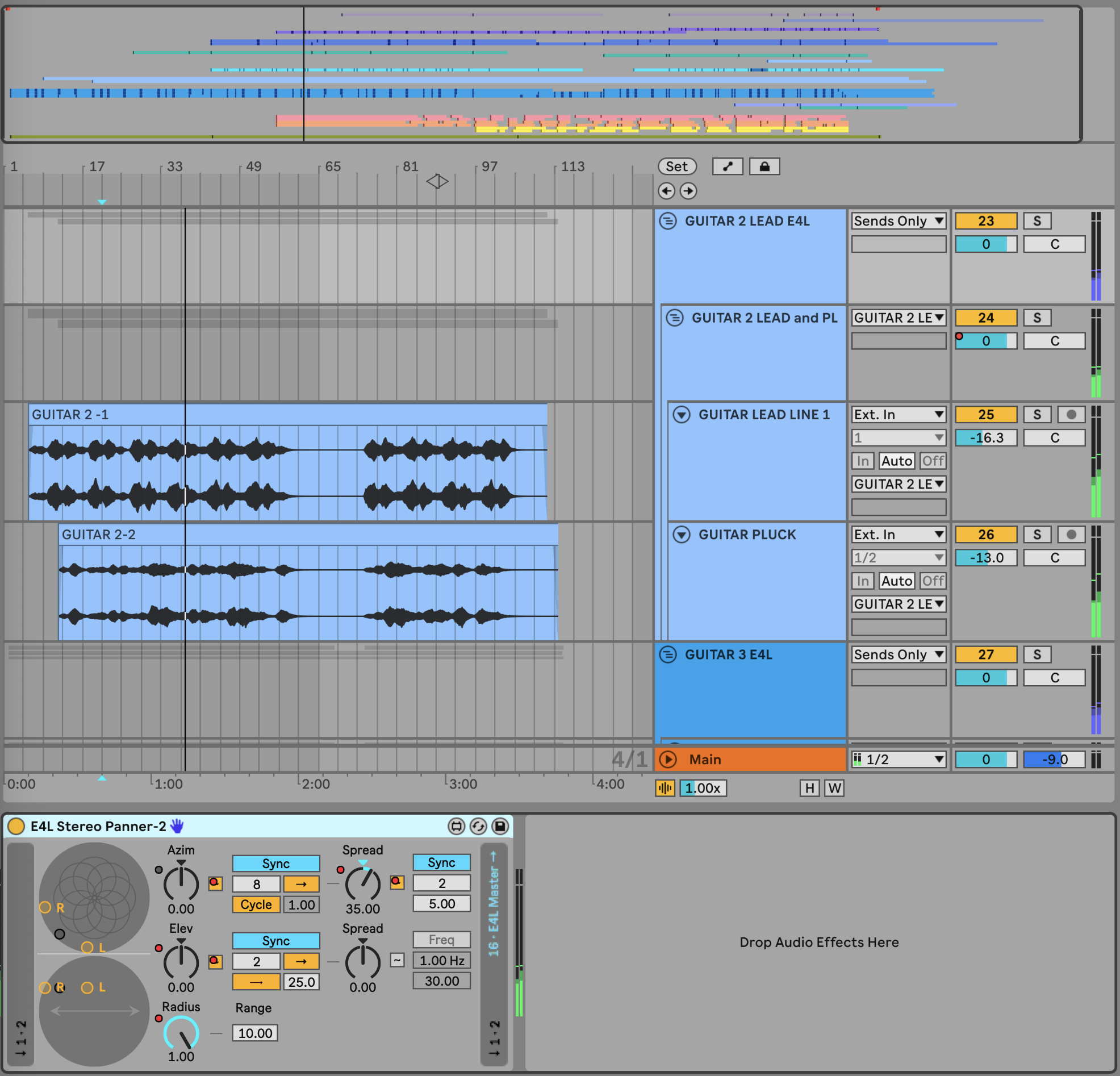
To use E4L, do you require a lot of technical knowledge or a deep understanding of Max for Live?
Once you place the E4L master bus into an audio track and select the way you want to listen to the sound, experimenting with the E4L panners and other effects is all very creative. So the cool thing about E4L is that you don't need to know anything about Max for Live or even spatial audio, but you definitely need to have Ableton Live Suite because it has Max for Live integrated into it.
Are you planning to play New Moon in a live, spatial audio setting?
My dream is to perform New Moon, and all of my music with multiple channels of sound all around the world. My favourite place to perform is at Envelop SF, which has 32 speakers, but this isn’t possible everywhere, so I’ll collaborate with other spaces and Envelop can support when it makes sense. For instance, we’ll be bringing immersive sound to a beautiful Daizenji temple in Gifu, and the historic Kanazawa shrine in Japan. I’ll also be performing on a quadraphonic system in Singapore and taking part in another collaboration in Taipei, Taiwan. I still love to play stereo sets at other venues, and will do that on tour, but I'm most passionate about creating physical, technical and emotional spaces for listening so that the music can be felt to its fullest potential.
Keep up with Christopher Willits on his website
Text and interview: Danny Turner
Photos courtesy of Ryan Kleeman and Sophia Shen